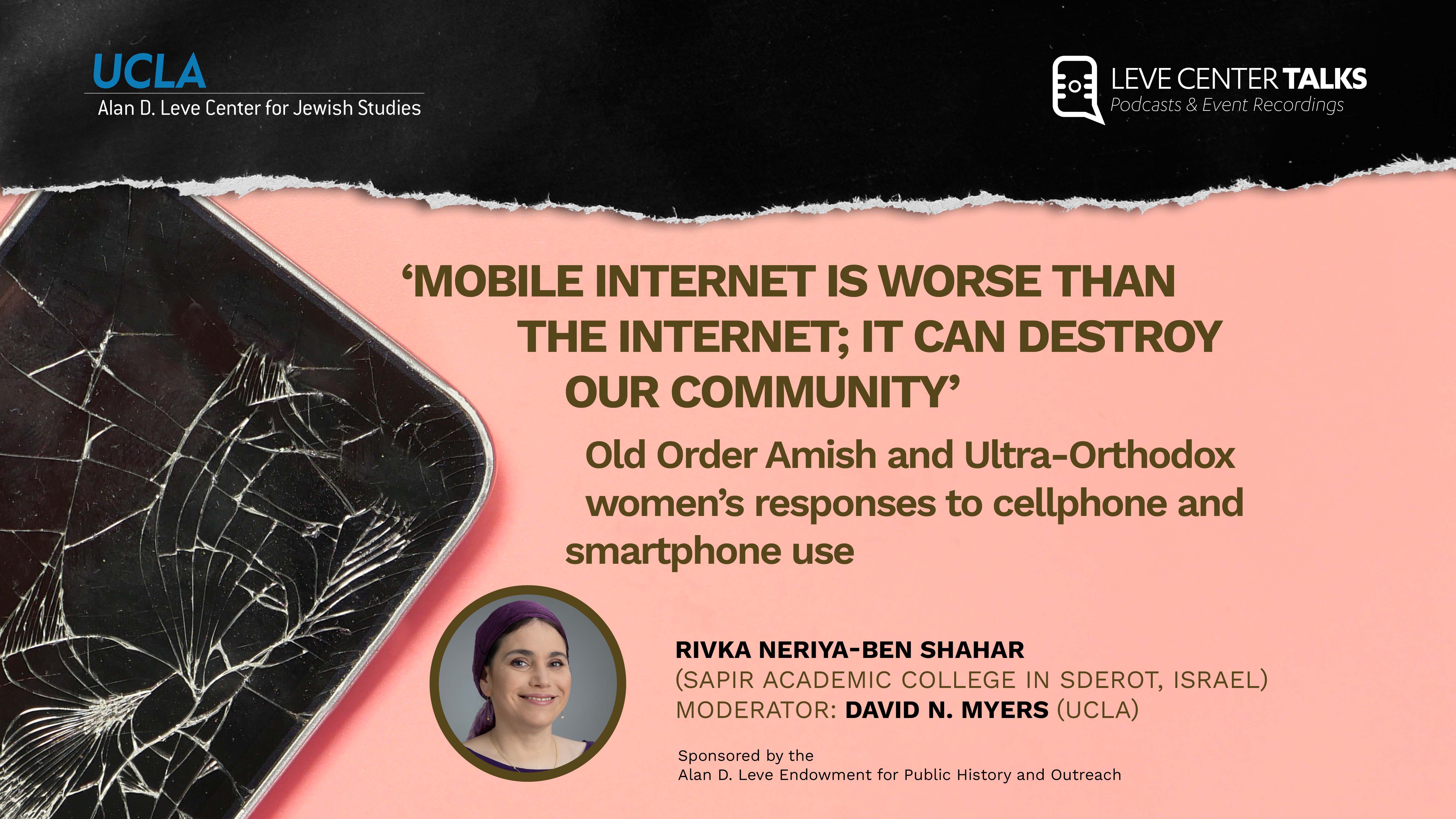
Old Order Amish and Ultra-Orthodox women’s responses to cellphone and smartphone use
Rivka Neriya-Ben Shahar (Katz Center at Penn) Moderator: David N. Myers (UCLA)
June 5, 2025
This study examines cellphone and smartphone use among Amish and ultra-Orthodox Jewish women, focusing on their exposure, perceptions, and symbolic interpretations. Despite differing levels of cellphone use (Amish mostly abstain; ultra-Orthodox use “kosher” phones), both groups reject smartphones due to beliefs that their content is impure. The women view smartphones as spiritually harmful, arguing that the device itself—not just its content—disrupts relationships with community, self, and God.
Sponsored by the Alan D. Leve Endowment for Public History and Outreach

Crossroads of Cultures: The Jezreel Valley in the Bronze and Iron Ages
Karen Covello-Paran (Israel Antiquities Authority) Moderator: William Schniedewind (UCLA)
May 27, 2025
The Jezreel Valley, Israel’s largest and most fertile valley, was a key center of social, cultural, and economic activity in the second and first millennia BCE. This lecture examines Canaanite cities, Egyptian rule, and the Kingdom of Israel through archaeology, highlighting how rural communities adapted to changing political powers and how these interactions shaped the valley’s history.

Landscapes of Print: Jews, Arabs, and Judeo-Arabic in Colonial North Africa
Noam Sienna (University of Toronto) Moderator: Aomar Boum (UCLA)
May 22, 2025
This talk examines the 19th-century effort in North Africa to cultivate a modern “Arab Jewish” or “Judeo-Arabic” reading public. Sienna explores the Judeo-Arabic printing industry and how Maghrebi Jews engaged with shifting linguistic and political forces—including colonialism, imperialism, and competing nationalisms. Drawing from his upcoming monograph, he highlights how North African Jews sought to shape complex, intersectional modern identities at the crossroads of Arabness and Jewishness. The talk asks: did they succeed—and what can we learn from their struggle today?
The Maurice Amado Program in Sephardic Studies

Between Two Worlds: Jewish War Brides After the Holocaust
Robin Judd (Ohio State University) Moderator: Jared McBride (UCLA)
May 13, 2025
After the Holocaust, many Jewish survivors and leaders saw marriage between Jews and military personnel as a way to rebuild and repopulate the Jewish community. Historian Robin Judd, whose grandmother married an American soldier after liberation, explores the experiences of survivors who wed military personnel. She details the evolution of these unions—from courtship to immigration and settling in the U.S., Canada, and the UK—while highlighting the complex emotions of joy, guilt, grief, and the challenges of starting anew.
The 1939 Society Program in Holocaust Studies

Final Verdict: The Holocaust on Trial in the 21st Century
Tobias Buck (Journalist/Writer) Moderator: Jared McBride (UCLA)
May 8, 2025
On October 17, 2019, Bruno Dey’s trial begins in Hamburg, where he faces charges for his role in the murder of over 5,000 inmates at the Stutthof concentration camp during World War II, when he was a 17-year-old SS guard. This trial, taking place as the last survivors and perpetrators of the war pass away, raises significant questions about Germany’s history, politics, and collective memory. Tobias Buck uses the trial as a lens to explore his own family’s silence regarding their Nazi past, particularly his grandfather’s responsibility, while reflecting on the individual’s role in a murderous regime.
The 1939 Society Program in Holocaust Studies

Haredi Women in the Arts in the Digital Age: Contradictions and Paradoxes
Jessica Roda (Georgetown) Moderator: Mark Kligman (UCLA)
May 1, 2025
Ultra-Orthodox women artists, like Bracha Jaffe and Devorah Schwartz, have captivated large audiences with music videos, films, and Yiddish plays, yet remain largely unnoticed due to their communities’ emphasis on privacy. Popular portrayals, such as Netflix’s Unorthodox, often depict Hasidic women as uncreative and subordinate, overlooking their vibrant artistic worlds. This talk will explore the hidden creative spaces of Hasidic women, their rise to public performance, and their efforts to reshape perceptions of Hasidic life. Despite the rarity of celebrity status, figures like Jaffe and Shaindy Platzer have made a significant impact on Jewish music and culture.
Book Talk

Rethinking the Dilemma of Bombing Auschwitz: Support, Opposition, and Reservation
Zohar Segev (University of Haifa) Moderator: David N. Myers (UCLA)
April 3, 2025
The deportation of Jews from Hungary to Auschwitz-Birkenau began in May 1944, and the camp’s location within range of Allied bombers led to calls for its bombing. The camp was never bombed, and this failure has become a symbol of the powerlessness of both the free world and Jewish leadership to save Europe’s Jews. New research into the archives of American Jewish activists, particularly Leon Kubowitzki of the World Jewish Congress, reveals that Jewish and Zionist leaders requested the US not to bomb Auschwitz. Instead, they sought alternative military actions. This strategic approach, often dismissed by scholars, was a significant effort to weaken the camp’s operations without direct bombing.
The 1939 Society Program in Holocaust Studies
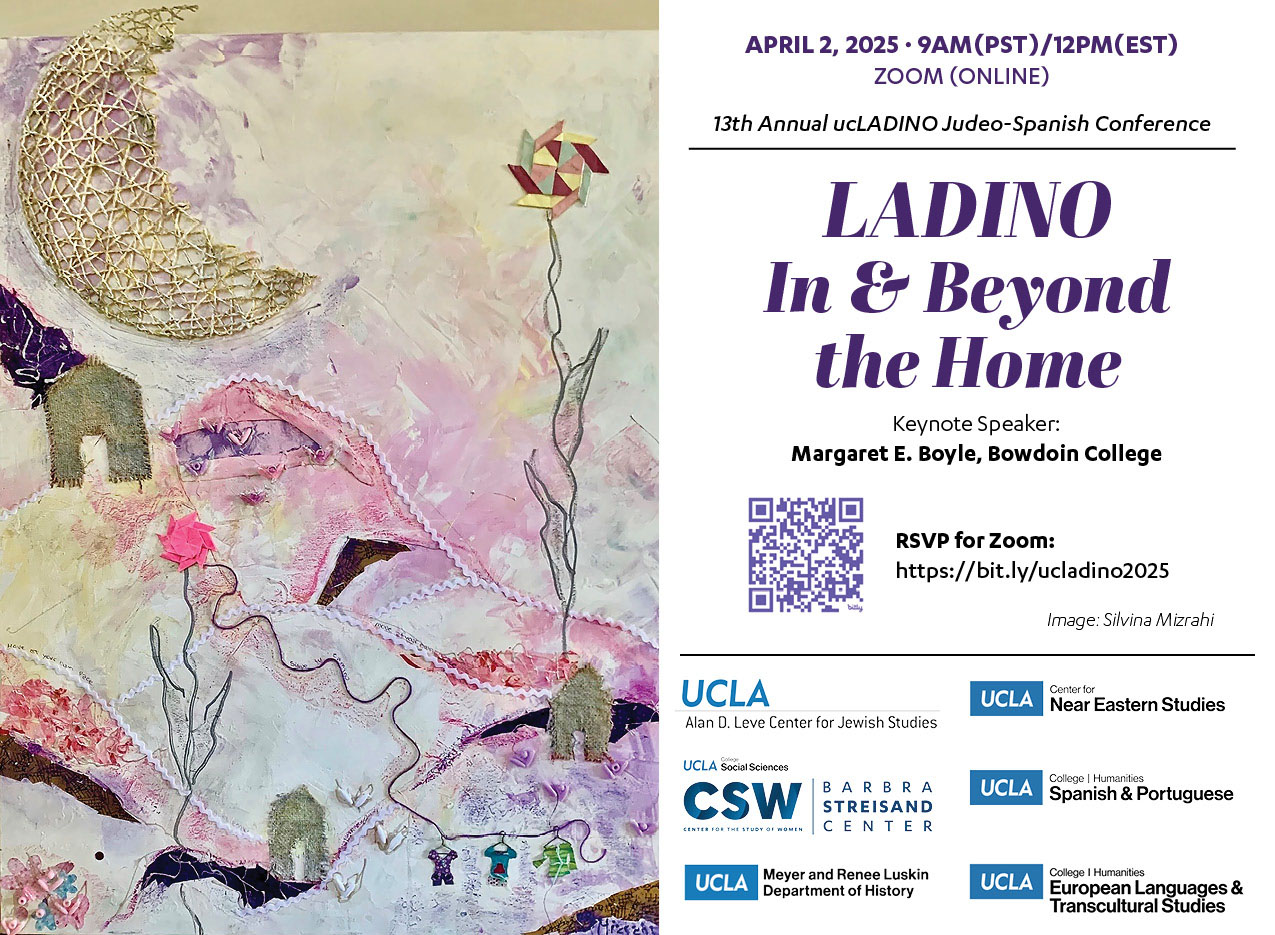
Ladino In & Beyond the Home – 13th Annual ucLADINO Judeo-Spanish Conference
April 2, 2025
In its thirteenth consecutive year, the ucLADINO conference supports and celebrates the growing preservation of Ladino language and culture in the Judeo-Spanish diaspora. The theme for this year’s ucLADINO conference centers around Ladino in and beyond the home, exploring language and culture in domestic spaces and in migration. How has Ladino taken shape within domestic worlds and how has Ladino adapted in transit, carried from one home to the next?
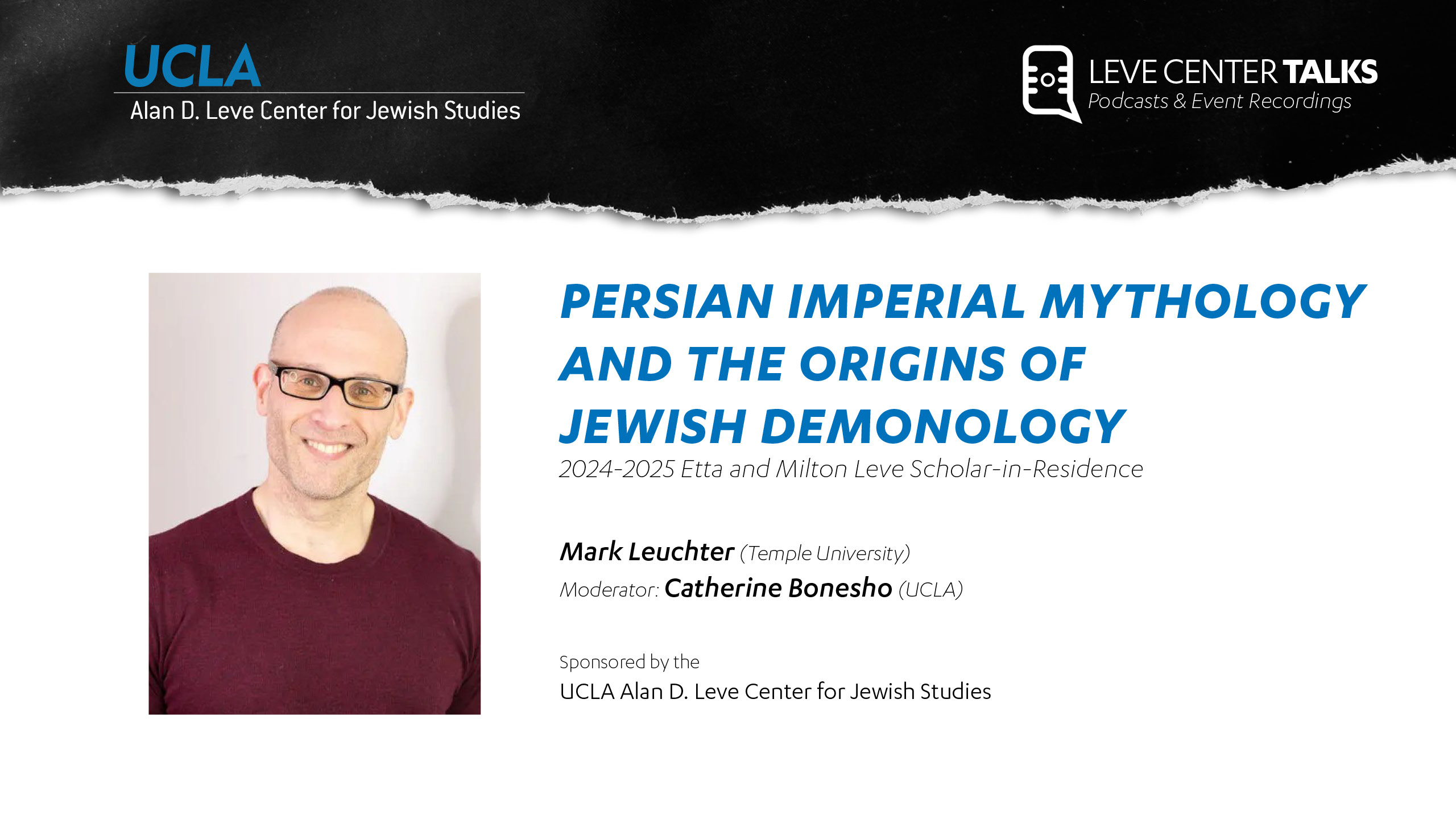
Persian Imperial Mythology and the Origins of Jewish Demonology
Mark Leuchter (Temple University) Moderator: Catherine Bonesho (UCLA)
March 12, 2025
Jewish literature of the Hellenistic period and beyond evidences a steady increase in lore about demons and their dangers. These beings are agents of chaos, threats to the created order, enemies of God and dangers to the safety and integrity of Jewish life. But contrary to scholars who see this as a result of the encounter with Hellenism, the origins of this concept of demonology can be traced to the experience of Jews in Persian Yehud and the function of Achaemenid mythology within imperial society. The rise of demonology is coeval and indeed coextensive with the fall of the Persian empire and the implications of a failed myth of imperial order.
Etta and Milton Leve Scholar in Residence Series
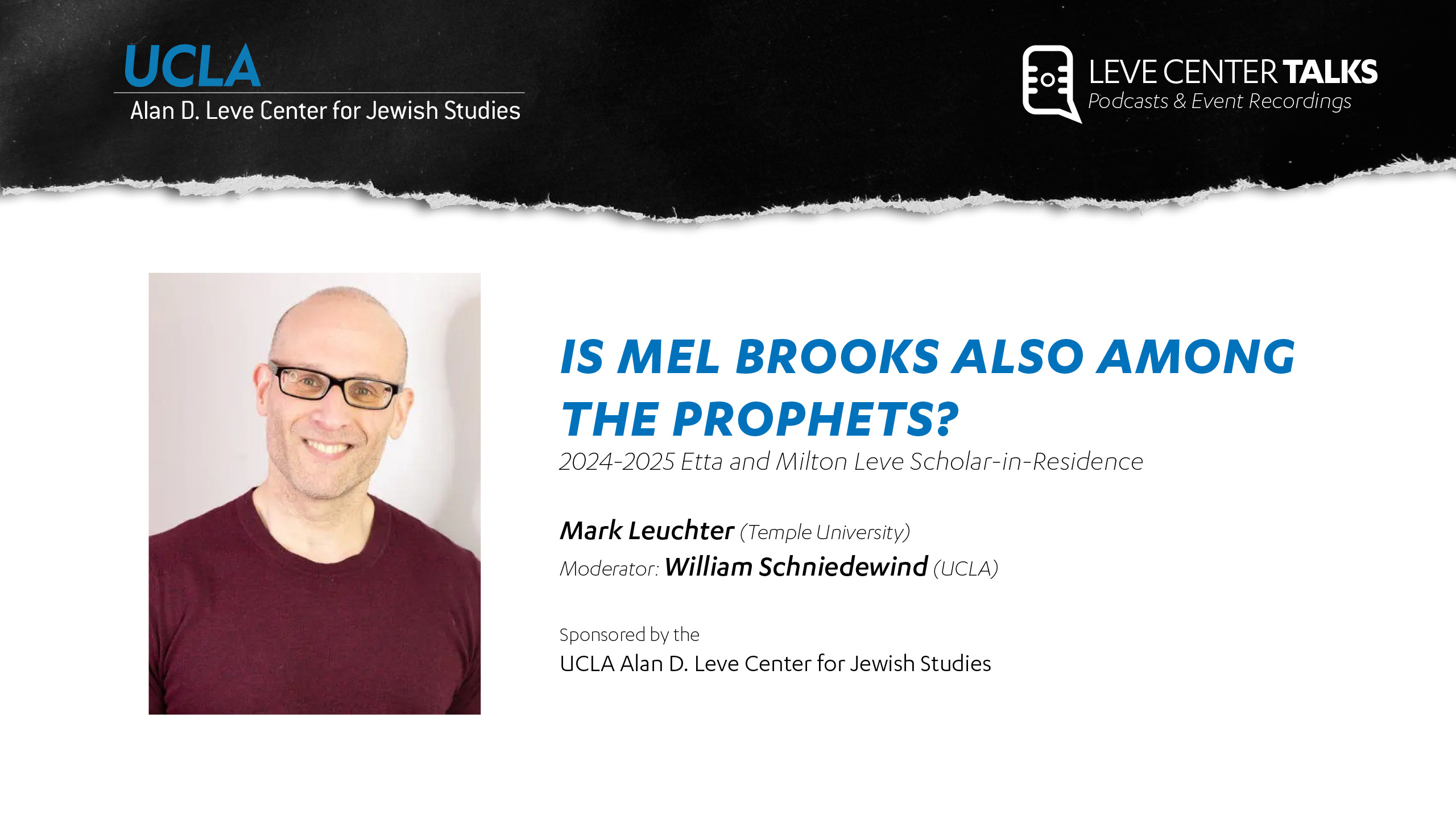
Is Mel Brooks Also Among the Prophets?
Mark Leuchter (Temple University) Moderator: William Schniedewind (UCLA)
March 11, 2025
Jewish tradition is a cornerstone of Mel Brooks’s films, in both explicit and implicit ways. An example of the latter is a moment in his 1974 film Blazing Saddles that uses the trope “the People of the Land” found throughout classical Jewish discourse and early rabbinic literature, with biblical origins. Brooks’s use of this trope has very strong points of contact with the prophetic literature of the Hebrew Bible, which also engages this language for humorous purposes. But the humor in the prophetic texts is deployed not for laughs but for shock value, presenting audiences with a radically different understanding of what “the People of the Land” had come to mean by their day. In a subtle way, Brooks’s use of the term does the same. So…is Mel Brooks also among the prophets?
Etta and Milton Leve Scholar in Residence Series
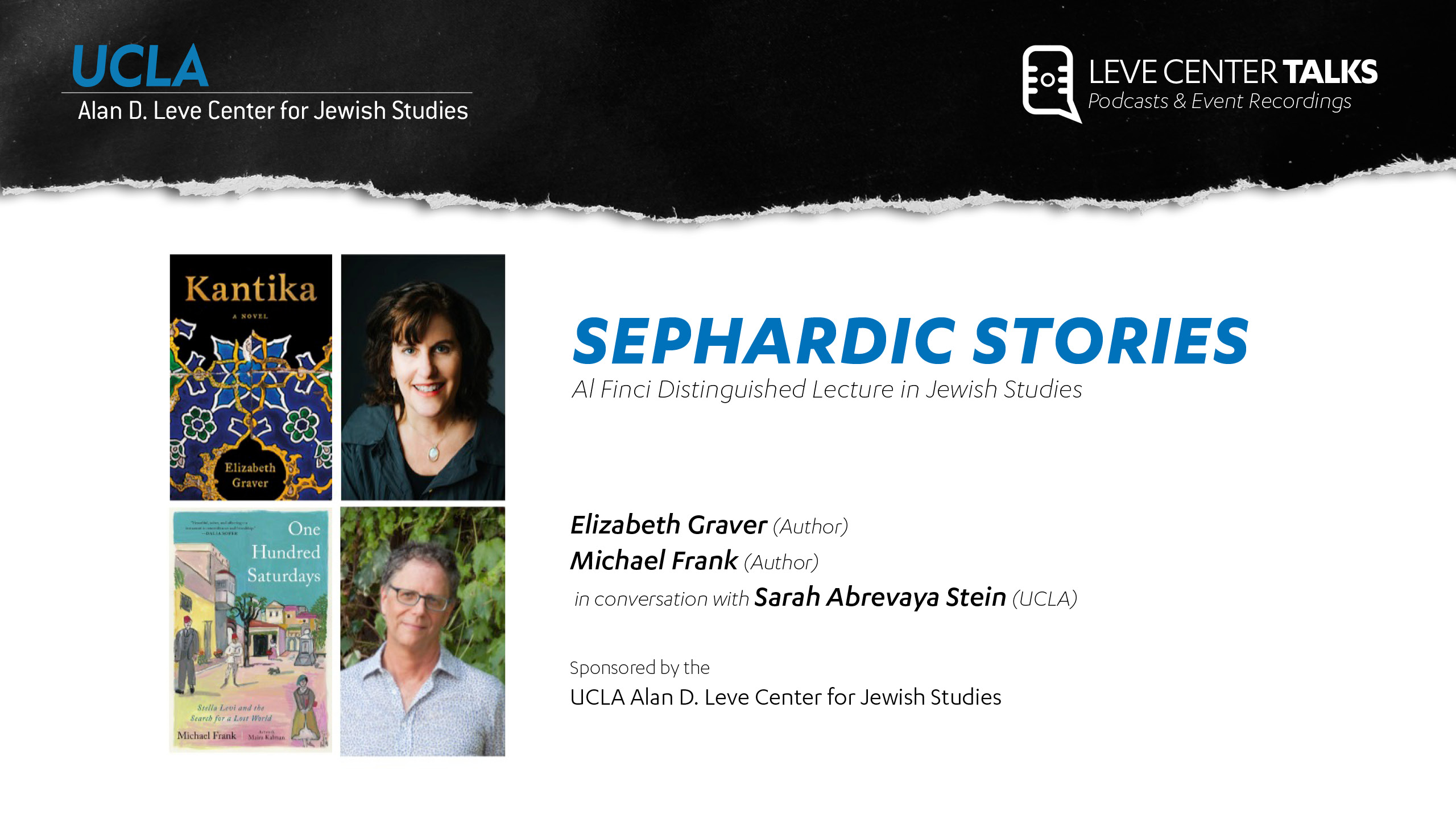
Sephardic Stories
Elizabeth Graver (Author) and Michael Frank (Author) with Sarah Abrevaya Stein (UCLA)
March 6, 2025
For this year’s Al Finci Memorial Lecture two award-winning authors gather to discuss their writing and what drew them to Sephardic stories. Elizabeth Graver’s fifth novel, Kantika (Metropolitan Books/Holt, 2023), is a dazzling multi-generational saga that moves from Istanbul to Barcelona, Havana, and New York, exploring themes of displacement, endurance, family, and home.
Michael Frank’s One Hundred Saturdays: Stella Levi and the Search for a Lost World (Avid Reader Press, 2022), tells the remarkable story of the now hundred-and-one-year-old Stella Levi whose conversations with the author over the course of six years bring to life the vibrant world of Sephardic Jewish Rhodes, the deportation to Auschwitz that extinguished ninety percent of her community, and the resilience and wisdom of the woman who lived to tell the tale.
Al Finci Distinguished Lecture in Jewish Studies
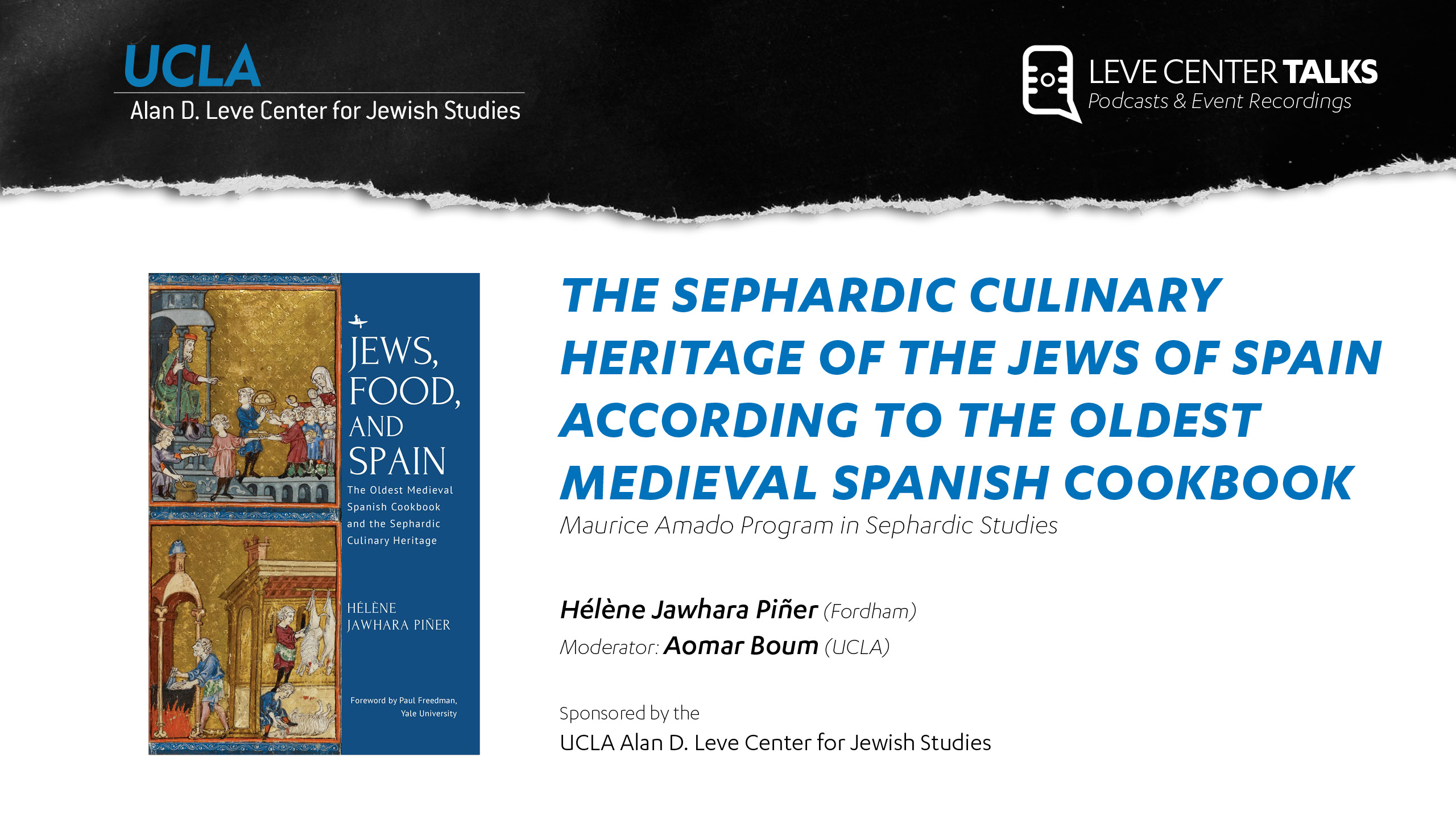
Sephardic Culinary Heritage of the Jews of Spain According to the Oldest Medieval Spanish Cookbook
Hélène Jawhara Piñer (Fordham) Moderator: Aomar Boum (UCLA)
March 4, 2025
The transmission of Jewish culinary traditions has been crucial in shaping the Sephardic culinary heritage, reflecting the resilience and identity of Jewish communities in Spain. Despite historical challenges, Jewish cuisine has preserved its distinct flavors through family recipes and techniques. While modern Jewish cookbooks are common, medieval cookbooks, like the thirteenth-century Kitāb al-ṭabīẖ from the Iberian Peninsula, are exceptional. This text is the oldest known source to mention Jewish recipes and provides insight into the multicultural environment of the time. The inclusion of Jewish recipes in this Arabic-written cookbook raises questions about cultural exchange and adaptation, offering a deeper understanding of Sephardic cuisine and Iberian society’s complex social dynamics.
Maurice Amado Program in Sephardic Studies
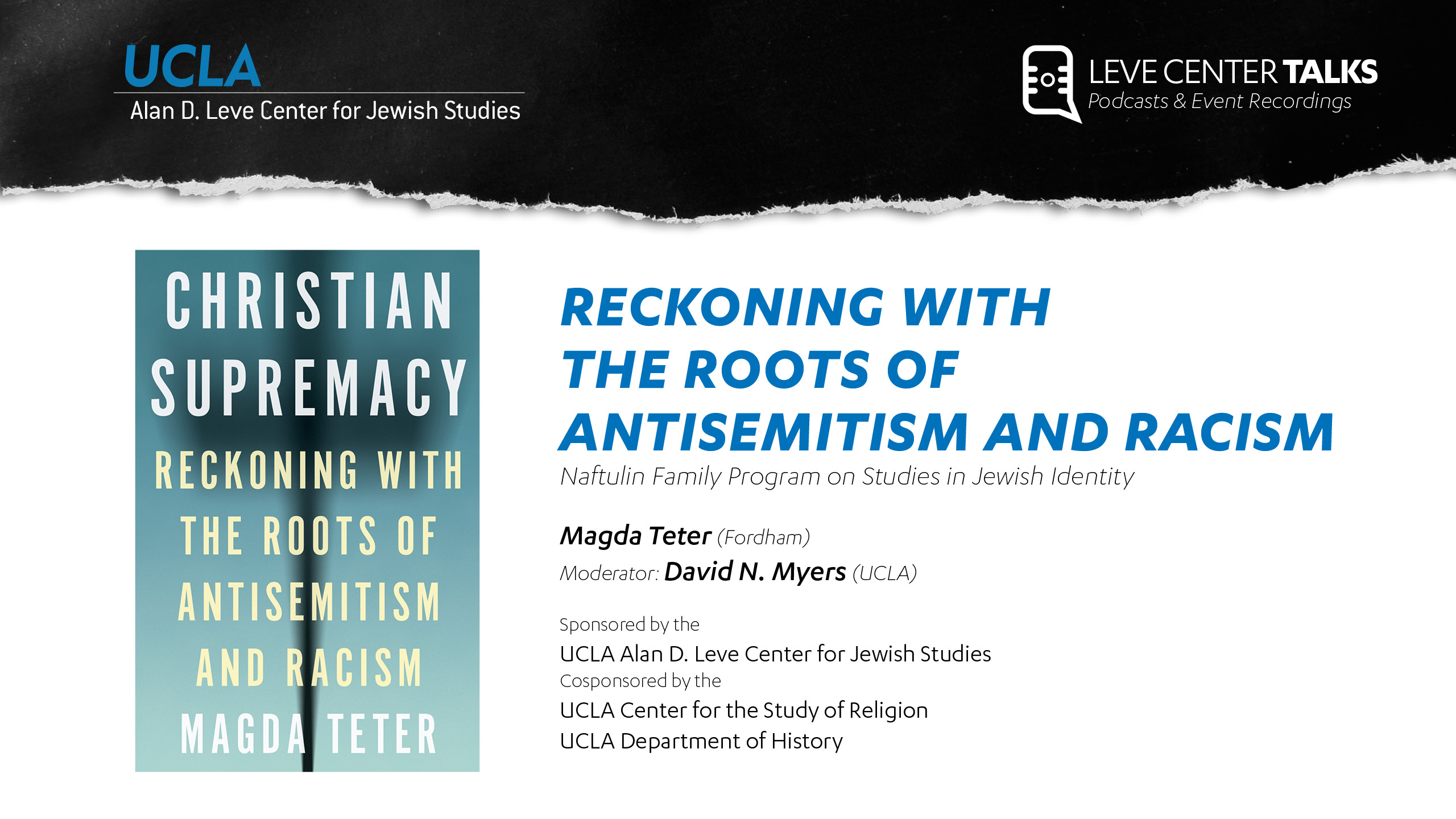
Reckoning with the Roots of Antisemitism and Racism
Magda Teter (Fordham) Moderator: David N. Myers (UCLA)
February 11, 2025
In 2017 in Charlottesville, antisemitism and anti-Black racism converged as white supremacists, in a highly choreographed and violent protest against the removal of a statue honoring a Confederate general, carried Confederate flags and chanted “Jews will not replace us.” In this talk, Magda Teter, the author of Christian Supremacy: Reckoning with the Roots of Antisemitism and Racism, will explain the deep roots of that connection and explore the interplay between Christian theology and law to demonstrate how legal and theological frameworks created centuries ago have led to the creation of social hierarchies, legal exclusion of and a denial of equality to Jews and Black people also in modern times.
Naftulin Family Program on Studies in Jewish Identity
Cosponsored by the UCLA Center for the Study of Religion and the UCLA Department of History

Ethics of the Algorithm: Digital Humanities and Holocaust Memory
Todd Presner (UCLA), Anna Bonazzi (UCLA), and Rachel Deblinger (UCLA) Moderator: Tim Cole (University of Bristol)
February 6, 2025
The Holocaust is one of the most documented events in history, with vast archives of audio, video, and written testimonies. Analyzing these resources manually would take lifetimes, but computational methods offer a way to process them more efficiently. This book by Presner and colleagues explores the ethical implications of using algorithms to “listen” to Holocaust testimonies. They propose developing an “ethics of the algorithm” that balances the need for ethical listening with the possibilities of digital tools. The book covers various technologies, from early computational approaches to AI-driven testimonies that simulate real conversations with survivors.
Michael and Irene Ross Program in Yiddish Studies
Cosponsored by the UCLA Program in Digital Humanities and the UCLA Center for European and Russian Studies
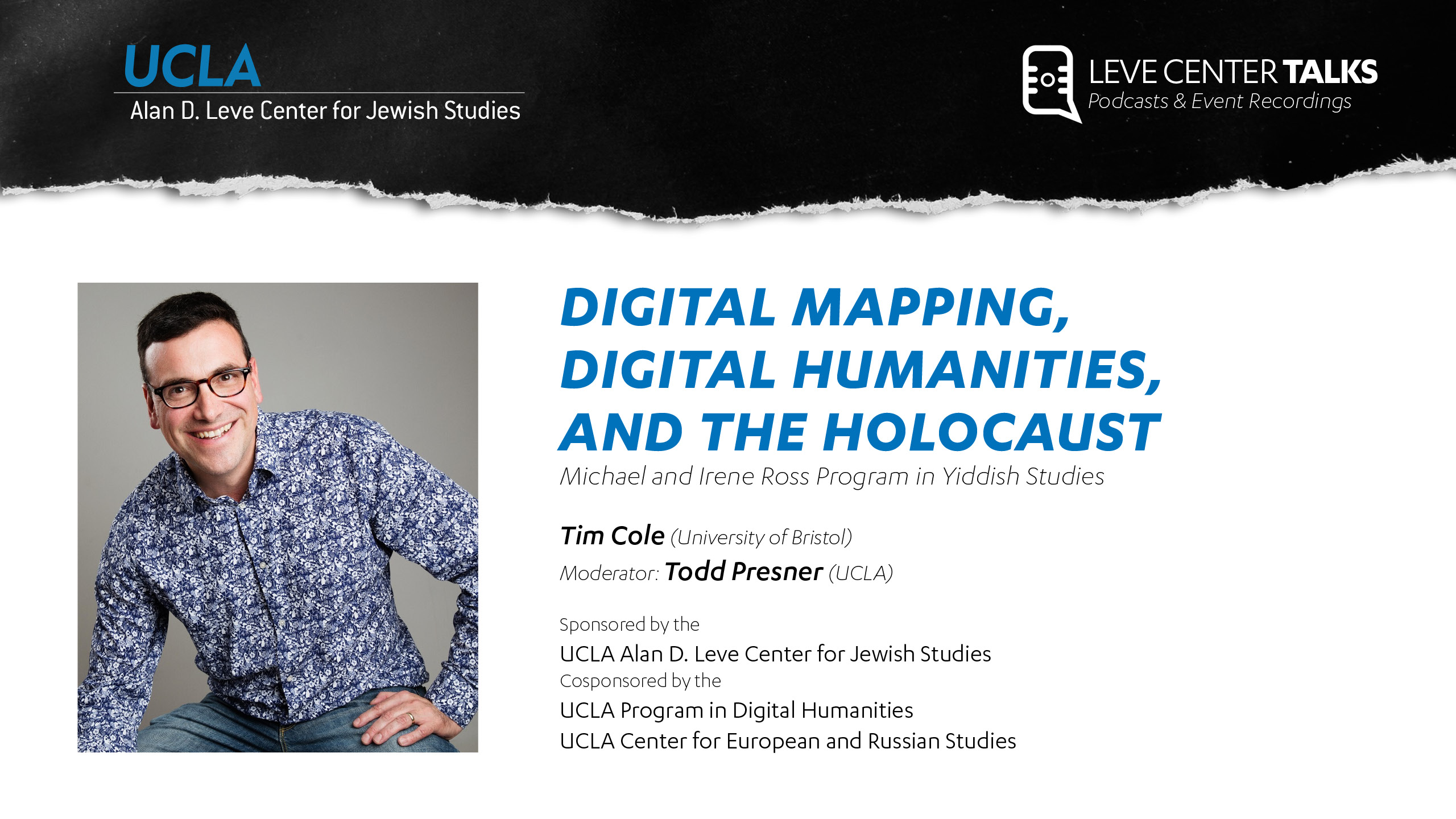
Digital Mapping, Digital Humanities, and the Holocaust
Tim Cole (University of Bristol) Moderator: Todd Presner (UCLA)
February 4, 2025
This talk draws on over ten years of experimenting with digital humanities methods – in particular digital mapping – to study the Holocaust. As well as suggesting the ways that a range of digital methods can uncover new knowledge through distant reading the archive, mapping spatial patterns, or digital reading against the grain, the talk also reflects on the limitations of such approaches. It asks when and how we decide to use, and not use, digital tools and methods in researching the Holocaust, and what kinds of new digital tools we might want to develop as well as when we choose to adopt more traditional analog methods.
Michael and Irene Ross Program in Yiddish Studies
Cosponsored by the UCLA Program in Digital Humanities and the UCLA Center for European and Russian Studies

The Pope at War: The Continuing Controversy over the Silence of Pope Pius XII during the Shoah
David I. Kertzer (Brown) Moderator: Aliza Luft (UCLA)
January 28, 2025
Pope Pius XII’s decision not to speak out against the German attempt to exterminate the Jews of Europe has long generated bitter controversy. The opening of the Vatican archives for his papacy in 2020 permits new insight into the reasons why the pope acted as he did. Focusing on the pope’s actions in October 1943 as the German SS rounded up over a thousand Jews in Rome, Kertzer, who has examined thousands of documents from the newly opened archives, offers a new perspective on what the pope did and why he acted as he did.
Viterbi Program in Mediterranean Jewish Studies
Cosponsored by the UCLA Center for the Study of Religion and the UCLA Department of European Languages and Transcultural Studies
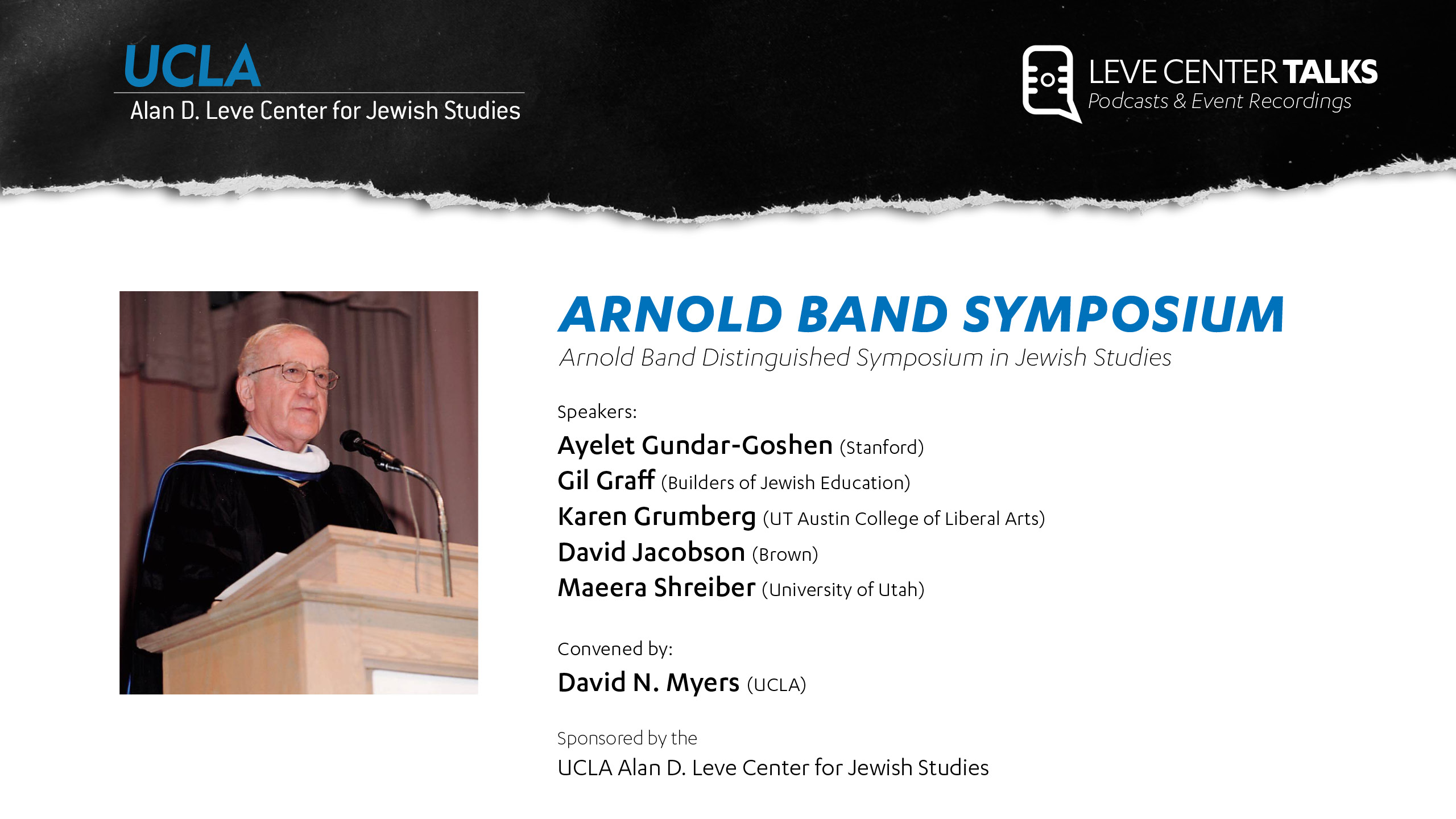
Arnold Band Symposium
Karen Grumberg (UT Austin College of Liberal Arts), David Jacobson (Brown University), Gil Graff (Builders of Jewish Education), Maeera Shreiber (University of Utah), and Ayelet Gundar-Goshen (Stanford University) Convened by David N. Myers (UCLA)
January 30, 2025
This symposium will bring together colleagues and students of Prof. Arnold Band to reflect on his wide-ranging impact and influence on their scholarly work. Prof. Band was known for his pioneering research in Hebrew and Jewish literature, though his range of interests expanded far beyond those domains. Panelists will reflect on how Prof. Band, the imprint he left on their work, and his broader impact on different fields of exploration.
Arnold Band Distinguished Symposium in Jewish Studies
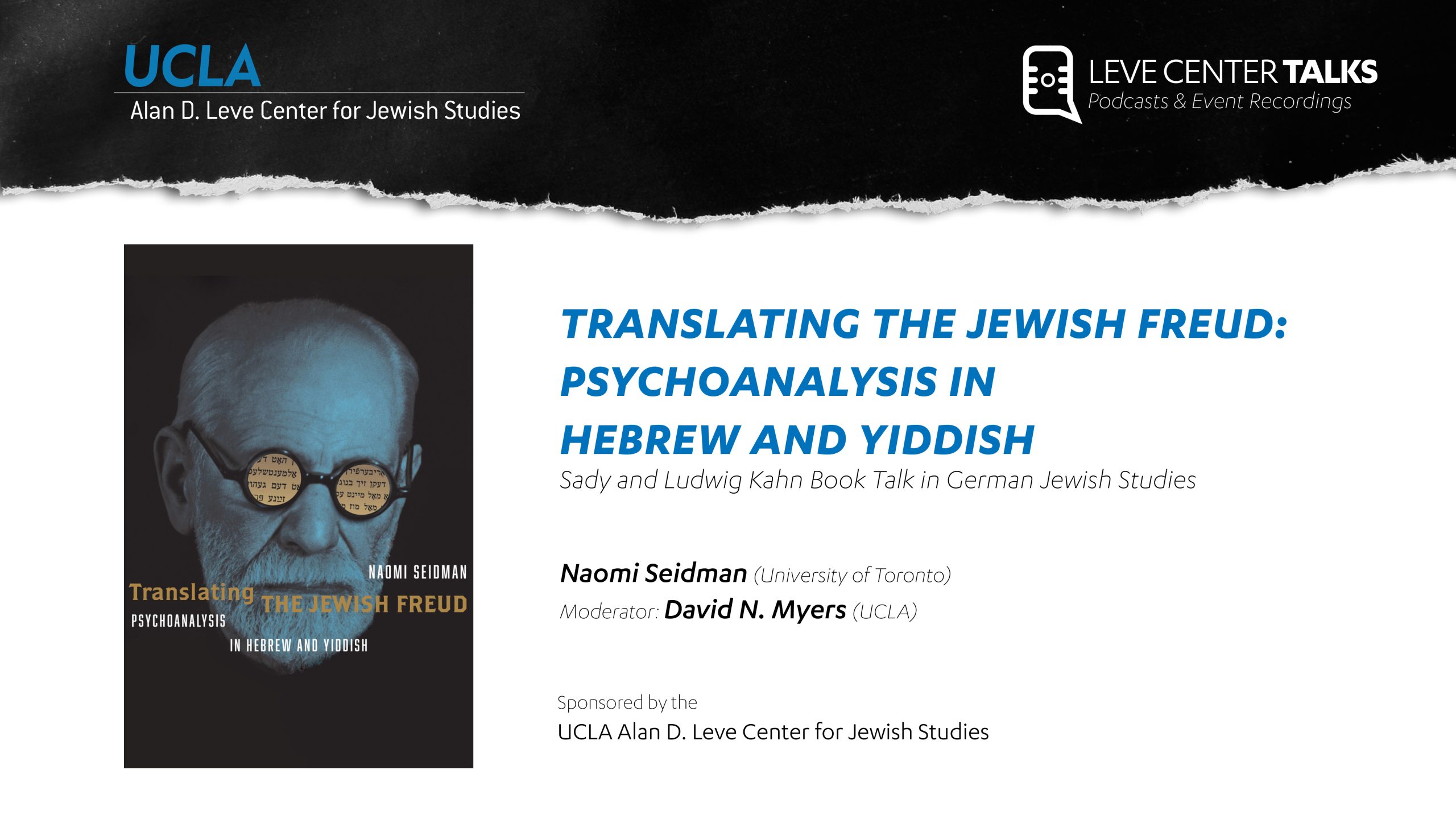
Translating the Jewish Freud: Psychoanalysis in Hebrew and Yiddish
Naomi Seidman (University of Toronto) Moderator: David N. Myers (UCLA)
November 19, 2024
The Jewish character of psychoanalysis is still a matter of debate. But what it not disputed is that Sigmund Freud considered the translations of his work into Hebrew and Yiddish a matter of profound significance, writing about how moved he was to hold these renderings in his hand when they were sent to him by the translators. This talk will introduce the translations that moved Freud so deeply and discuss the power of Jewish languages to create Jewish connections, beyond the question of whether Freud could read and understand these translations.
Sady and Ludwig Kahn Program in German Jewish Studies
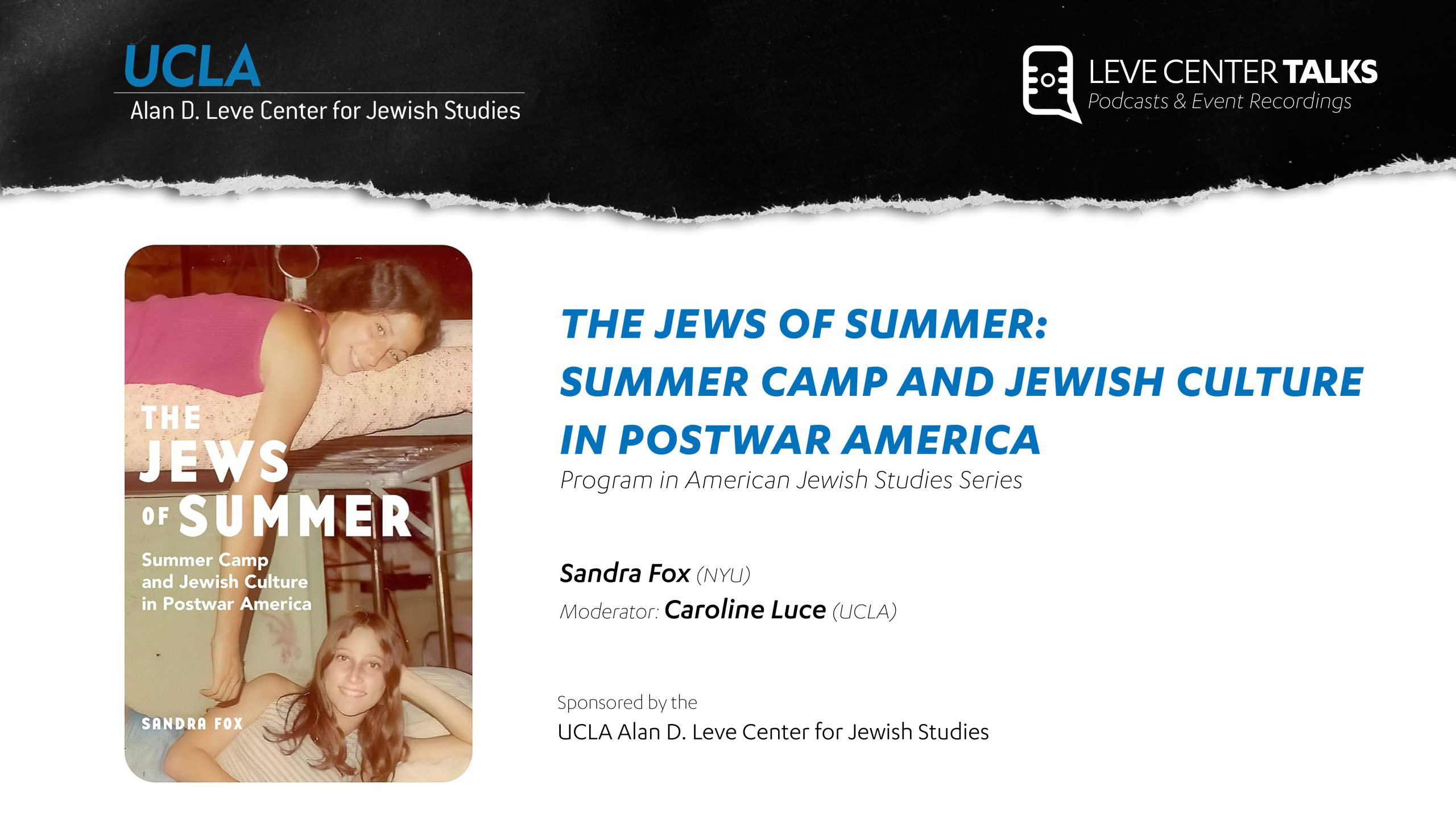
The Jews of Summer: Summer Camp and Jewish Culture in Postwar America
Sandra Fox (NYU) Moderator: Caroline Luce (UCLA)
January 21, 2025
In the decades directly following the Holocaust, American Jewish leaders anxiously debated how to preserve and produce what they considered authentic Jewish culture, fearful that growing affluence and suburbanization threatened the future of Jewish life. Many communal educators and rabbis contended that without intervention, Judaism as they understood it would disappear altogether. They pinned their hopes on residential summer camps for Jewish youth, institutions that sprang up across the U.S. as places for children and teenagers to socialize, recreate, and experience Jewish culture. In this lecture, Sandra Fox explains how a sense of cultural crisis birthed a rite of passage for Jewish children across the country: the American Jewish summer camp.
Program in American Jewish Studies
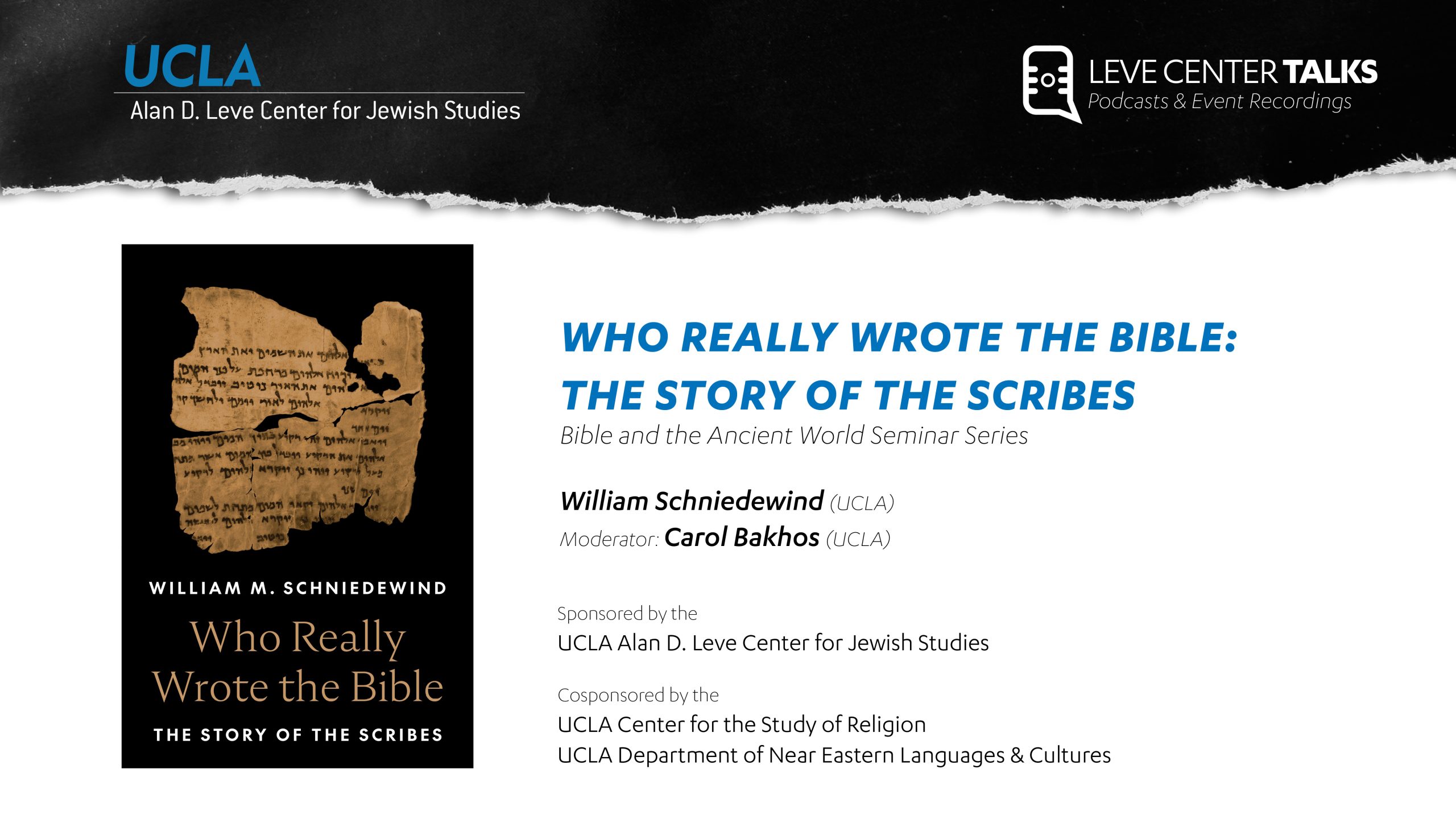
Who Really Wrote the Bible: The Story of the Scribes
William Schniedewind (UCLA) Moderator: Carol Bakhos (UCLA)
December 3, 2024
Who wrote the Bible? Its books have no bylines. Tradition long identified Moses as the author of the Pentateuch, with Ezra as editor. Ancient readers also suggested that David wrote the psalms and Solomon wrote Proverbs and Qohelet. Although the Hebrew Bible rarely speaks of its authors, people have been fascinated by the question of its authorship since ancient times. In Who Really Wrote the Bible, William Schniedewind offers a bold new answer: the Bible was not written by a single author, or by a series of single authors, but by communities of scribes. The Bible does not name its authors because authorship itself was an idea enshrined in a later era by the ancient Greeks. In the pre-Hellenistic world of ancient Near Eastern literature, books were produced, preserved, and passed on by scribal communities.
Bible and the Ancient World Seminar Series
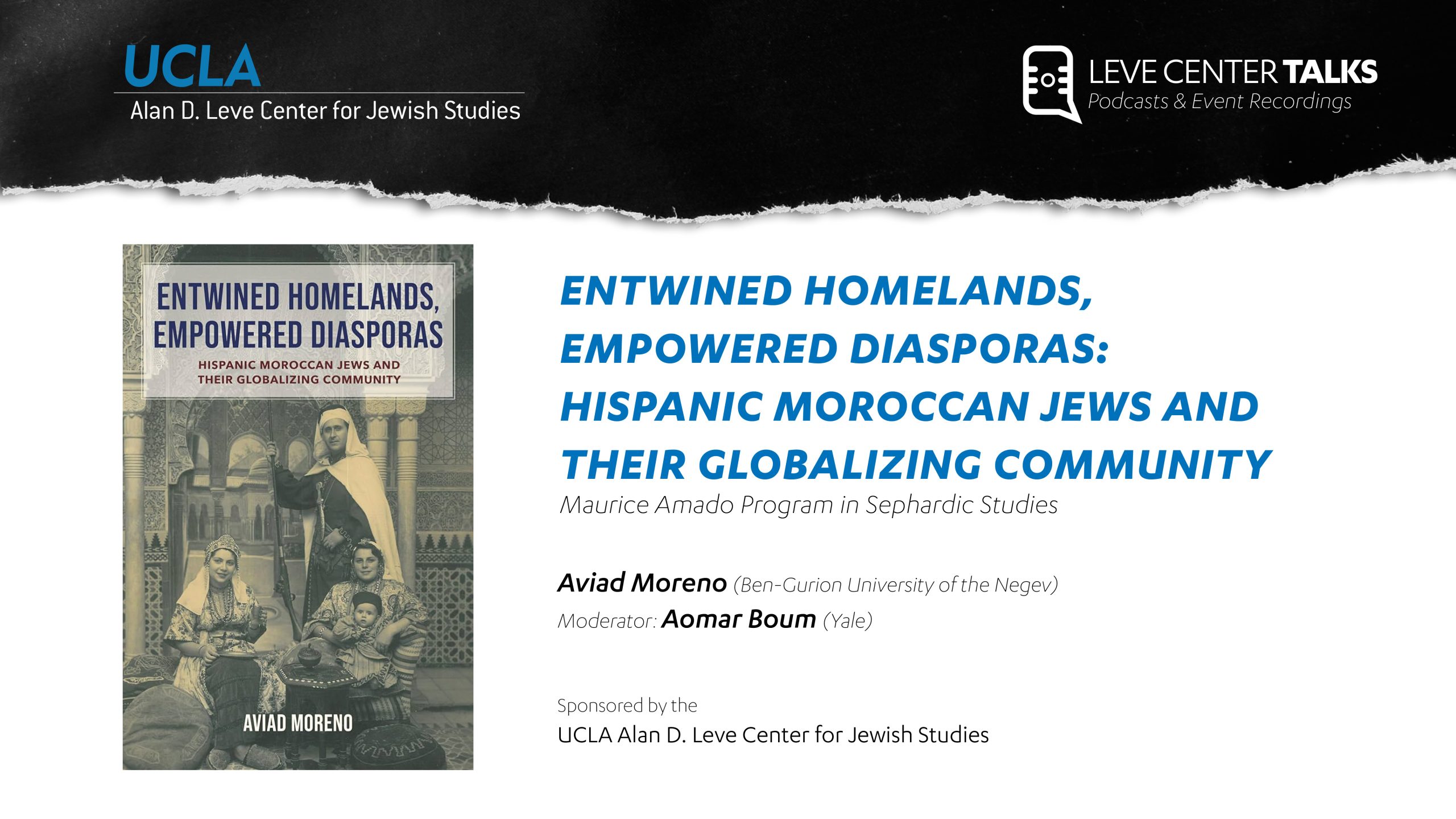
Entwined Homelands, Empowered Diasporas: Hispanic Moroccan Jews and Their Globalizing Community
Aviad Moreno (Ben-Gurion University of the Negev) Moderator: Aomar Boum (UCLA)
November 20, 2024
The Hispanic Moroccan Jewish diaspora emerged as one of the most mobile and globally dispersed North African groups in the twentieth century, with hubs in Venezuela, Argentina, Brazil, Peru, Spain, Israel, Canada, France, and the US, among others. Migration and diaspora scholars often focus on nostalgia as well as national and cultural ties to a single primary homeland. Based on his new book, Entwined Homelands, Empowered Diasporas: Hispanic Moroccan Jews and their Globalizing Community (Indiana University Press, 2024), Aviad Moreno will discuss with Aomar Boum how Hispanic Moroccan Jews developed layered historical ties to multiple homelands, from more traditionally considered centers like Morocco and the Holy Land, to countries in South America, and medieval Spain. Challenging the typical national framing of Moroccan Jewish migration, Moreno will explain how this small community strategically employed ties to multiple homelands, driven by transnational networks that interconnected their hypermobile diaspora.
Maurice Amado Program in Sephardic Studies
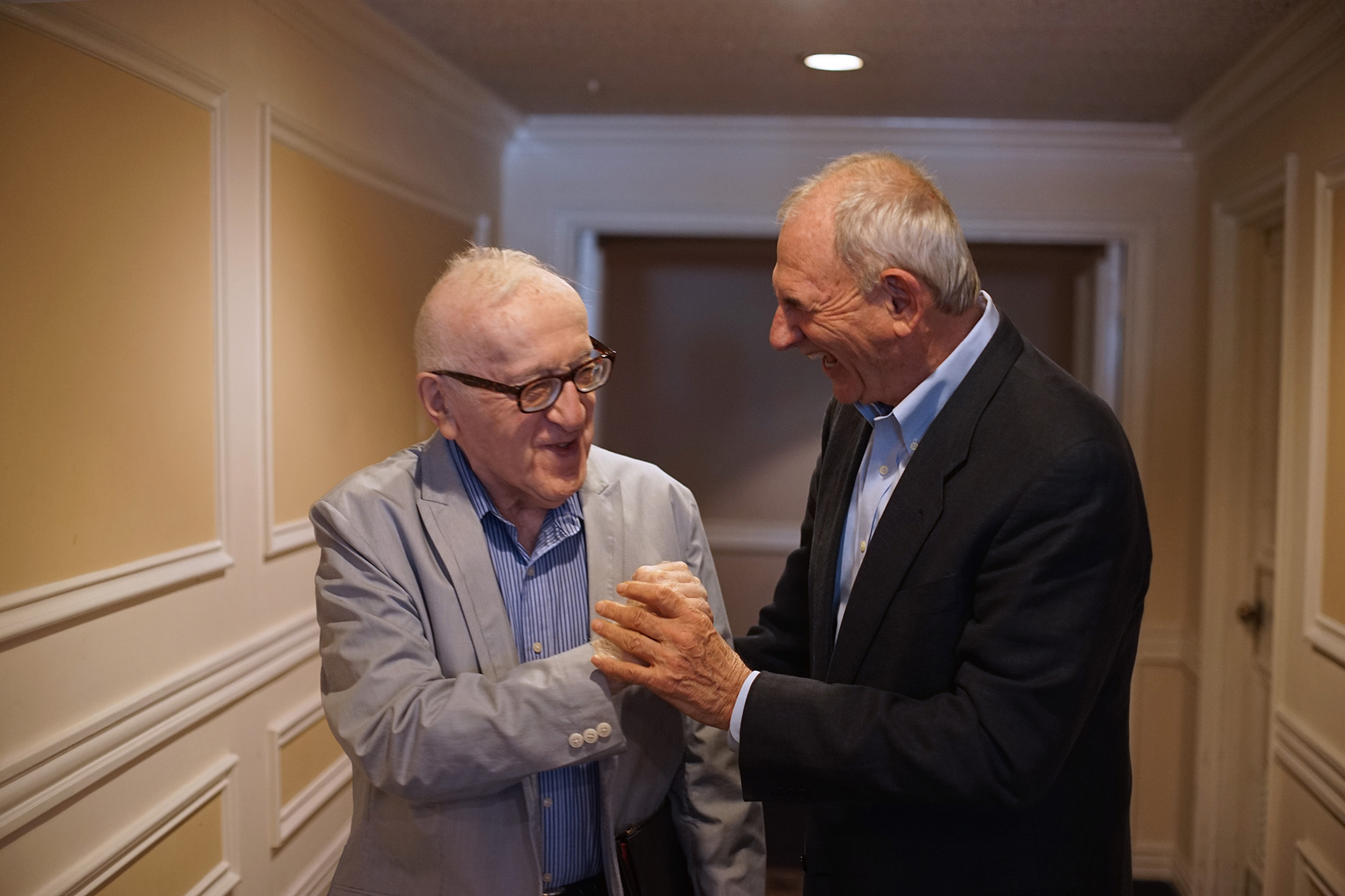
Arnold J. Band Memorial
October 28, 2024
Watch students, colleagues, friends, and family share personal memories of Professor Arnold J. Band. Professor Band taught at UCLA for more than 50 years and was the founder of the UCLA Center for Jewish Studies and the UCLA Department of Comparative Literature.