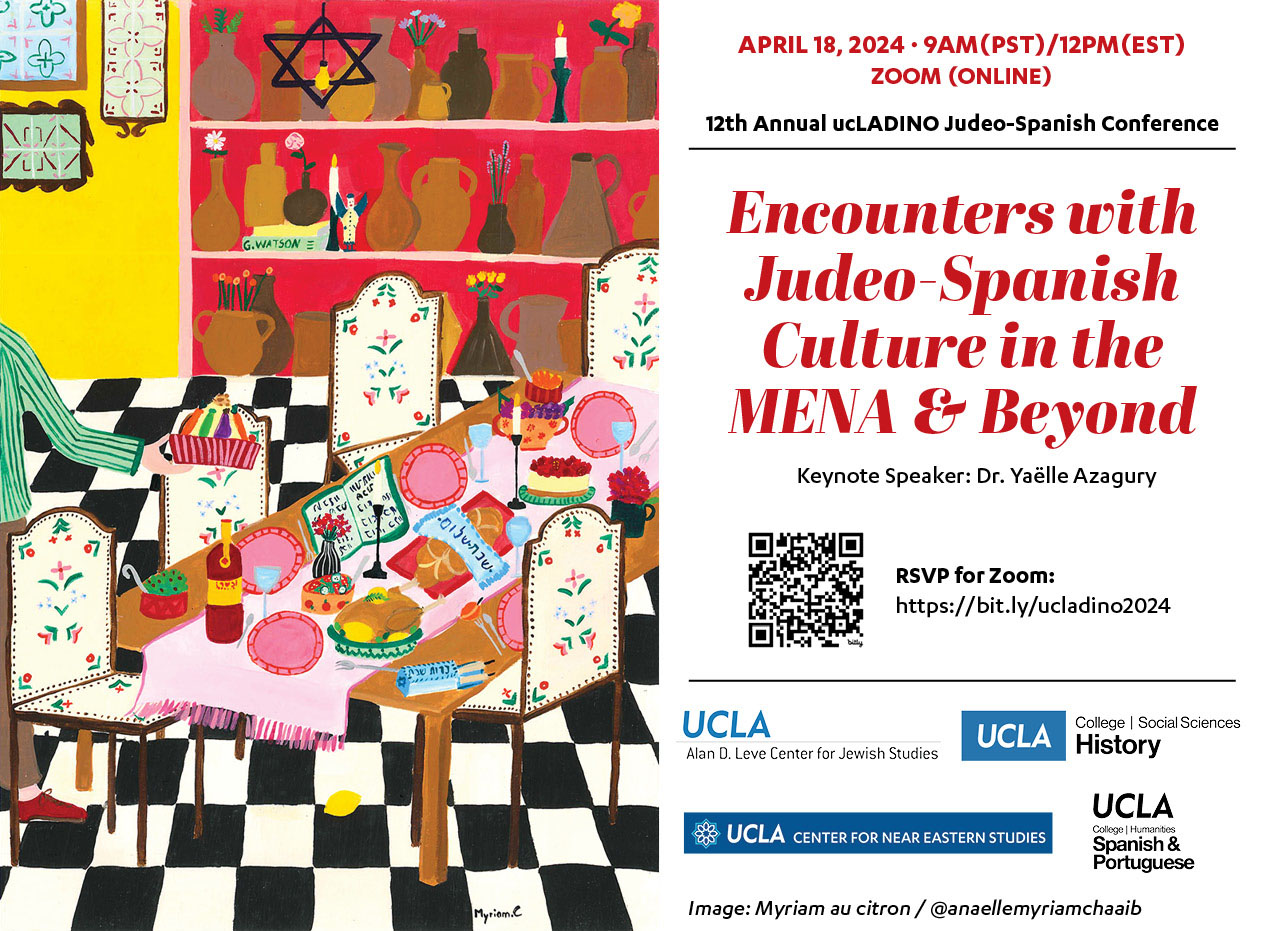
Encounters with Judeo-Spanish Culture in the MENA & Beyond (12th Annual ucLADINO Conference)
April 18, 2024
In its twelfth consecutive year, the ucLADINO conference continues to advocate for the preservation of Ladino language and culture in the Judeo-Spanish diaspora. The theme for this year’s ucLADINO conference, Encounters with Judeo-Spanish Culture in the MENA and Beyond, seeks to highlight the ways in which Judeo-Spanish speakers (including but not limited to Haketia and Ladino) came into contact with neighboring languages and cultures throughout its dynamic history. We conceptualize Judeo-Spanish encounters as moments of discovery, dialogue, and/or interaction.
Sponsored by the UCLA Alan D. Leve Center for Jewish Studies, the UCLA Department of Spanish & Portuguese, the UCLA Center for Near Eastern Studies, and the UCLA Department of History
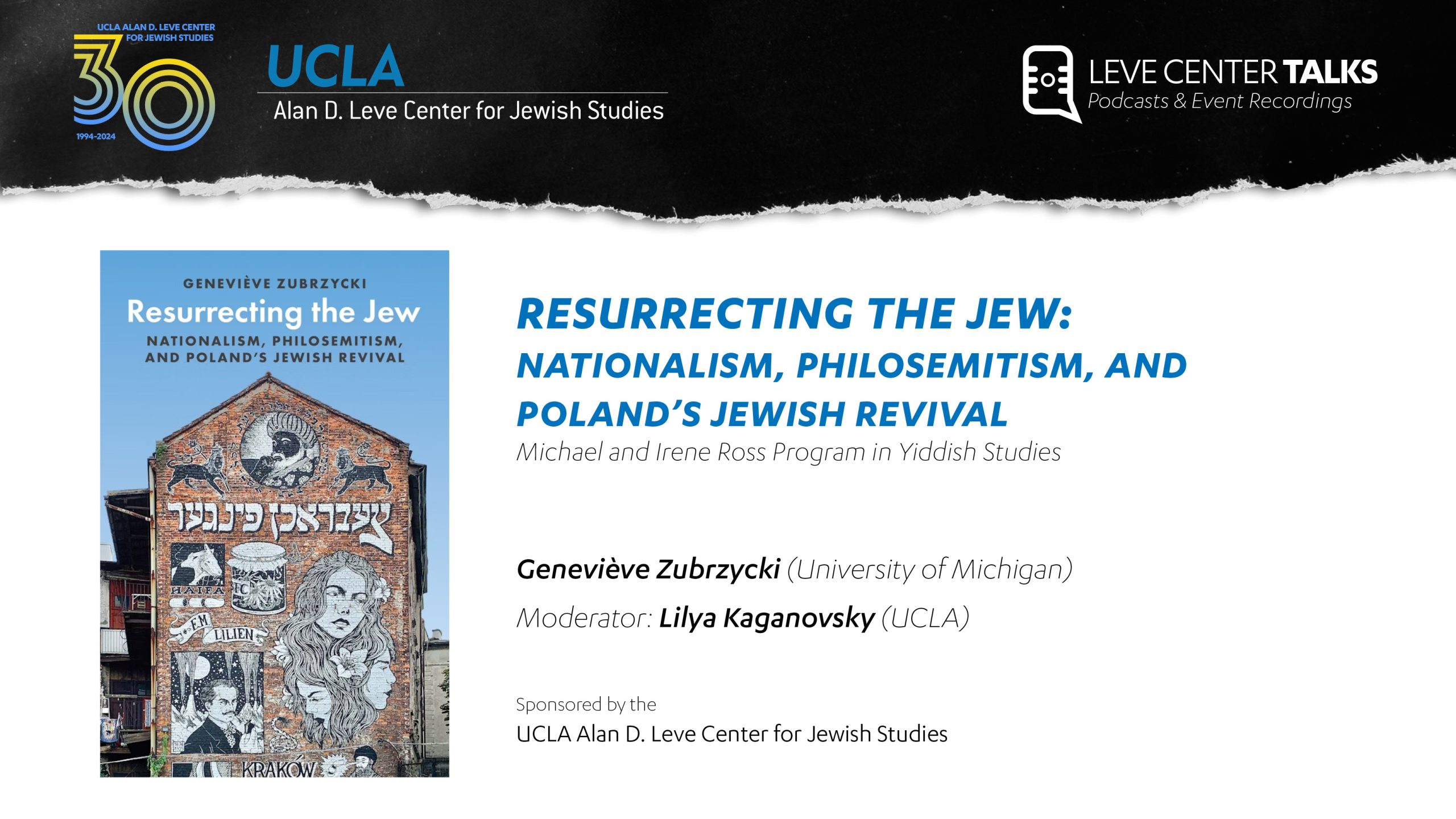
Resurrecting the Jew: Nationalism, Philosemitism, and Poland’s Jewish Revival
Geneviève Zubrzycki (University of Michigan) Moderator: Lilya Kaganovsky (UCLA)
April 16, 2024
Since the early 2000s, Poland has experienced a remarkable Jewish revival, largely driven by non-Jewish Poles with a passionate new interest in all things Jewish. Klezmer music, Jewish-style restaurants, kosher vodka, and festivals of Jewish culture have become popular, while new museums, memorials, Jewish studies programs, and Holocaust research centers reflect soul-searching about Polish-Jewish relations before, during, and after the Holocaust. In Resurrecting the Jew, Geneviève Zubrzycki examines this revival and asks what it means to try to bring Jewish culture back to life in a country where 3 million Jews were murdered and where only about 10,000 Jews now live.
Michael and Irene Ross Program in Yiddish Studies
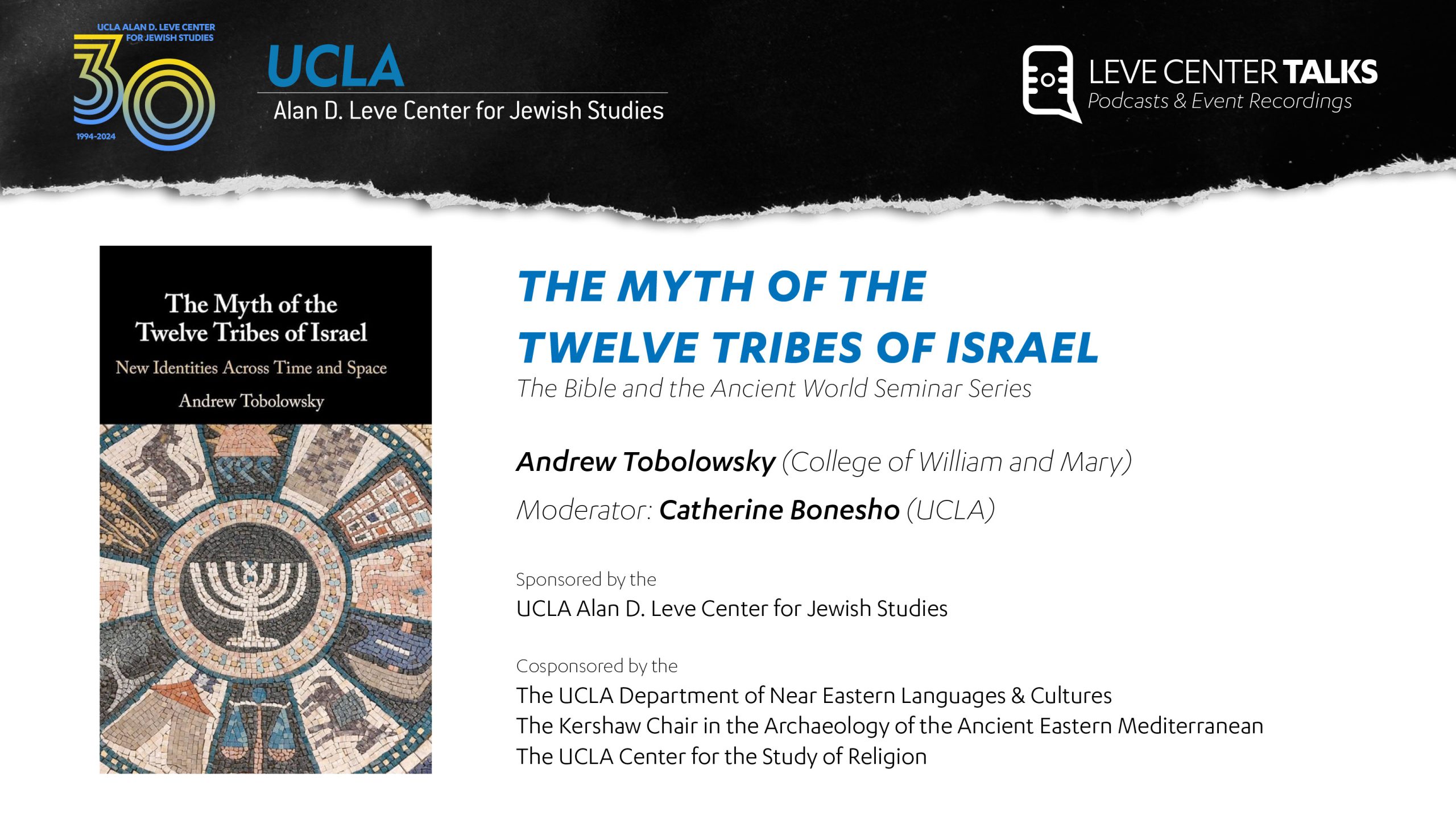
The Myth of the Twelve Tribes of Israel
Andrew Tobolowsky (College of William and Mary) Moderator: Catherine Bonesho (UCLA)
April 9, 2024
The story of the Twelve Tribes of Israel begins in the Hebrew Bible. But all around the world, there are stories about what happened next – which tribes went where, what might have happened to them, what they might have become. This paper, based on the book by the same name, explores what happens when we think of all of these as part of the same phenomenon: a history of efforts to create new visions of ancient Israel from the twelve tribes tradition that now spans more than 2,500 years and circles the globe.
The Bible and the Ancient World Seminar Series
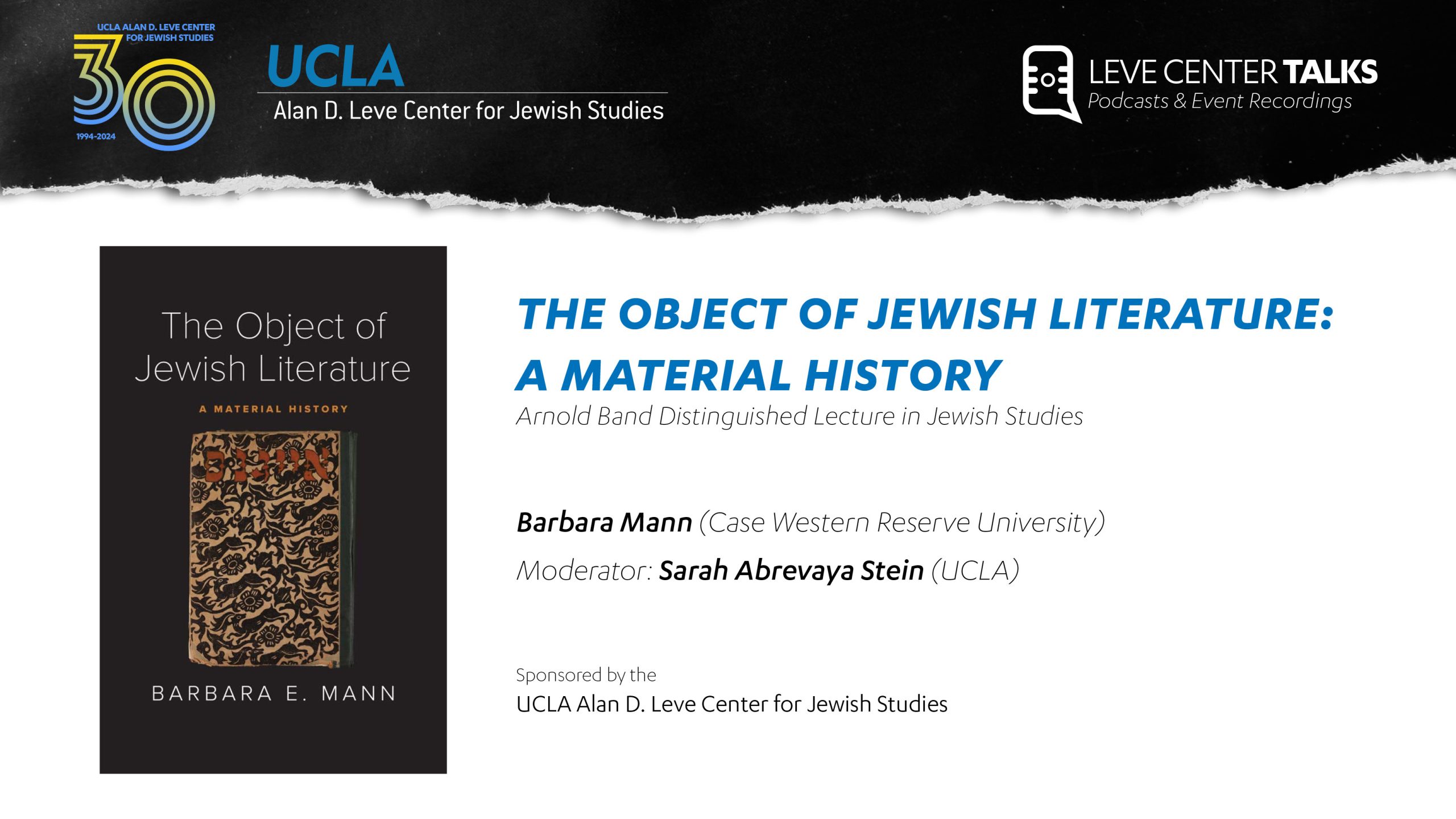
The Object of Jewish Literature: A Material History
Barbara Mann (Case Western Reserve University) Moderator: Sarah Abrevaya Stein (UCLA)
April 4, 2024
With the rise of digital media, the ‘death of the book’ has been widely discussed. But the physical object itself persists. Here, through the lens of materiality and objects, Barbara Mann tells a history of modern Jewish literature, from novels and poetry to graphic novels and artist’s books, offering a new frame for understanding how literary genres emerge.
Arnold Band Distinguished Lecture in Jewish Studies
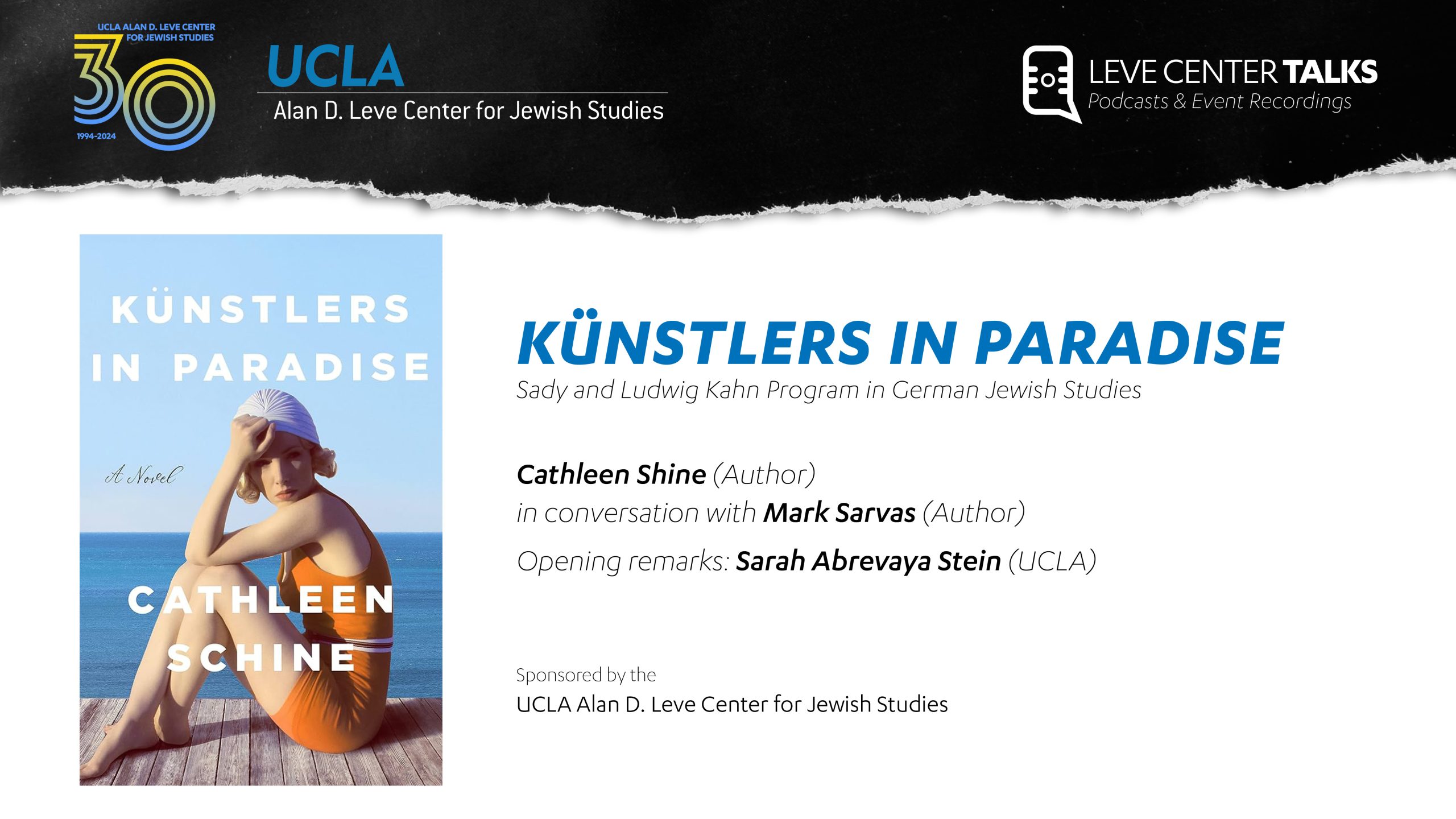
Künstlers in Paradise
Cathleen Shine (Author) in conversation with Mark Sarvas (Author) Moderator: Sarah Abrevaya Stein (UCLA)
April 1, 2024
For years Mamie Künstler, ninety-three-years-old, as clever and glamorous as ever, has lived happily in her bungalow in Venice, California with her inscrutable housekeeper and her gigantic St. Bernard dog. Their tranquility is upended when Mamie’s grandson, Julian, arrives from New York City. Like many a twenty-something, he has come to seek his fortune in Hollywood. But it is 2020, the global pandemic sweeps in, and Julian’s short visit suddenly has no end in sight.
Mamie was only eleven when the Künstlers escaped Vienna in 1939. They made their way, stunned and overwhelmed, to sunny, surreal Los Angeles where they joined a colony of distinguished Jewish musicians, writers and intellectuals also escaping Hitler. Now, faced with months of lockdown and a willing listener, Mamie begins to tell Julian the buried stories of her early years in Los Angeles: her escapades with eminent émigrés like Arnold Schoenberg, Christopher Isherwood, Thomas Mann. Oh, and Greta Garbo. While the pandemic cuts Julian off from the life he knows, Mamie’s tales open up a world of lives that came before him. They reveal to him just how much the past holds of the future.
Sady & Ludwig Kahn Book Talk in German Jewish Studies
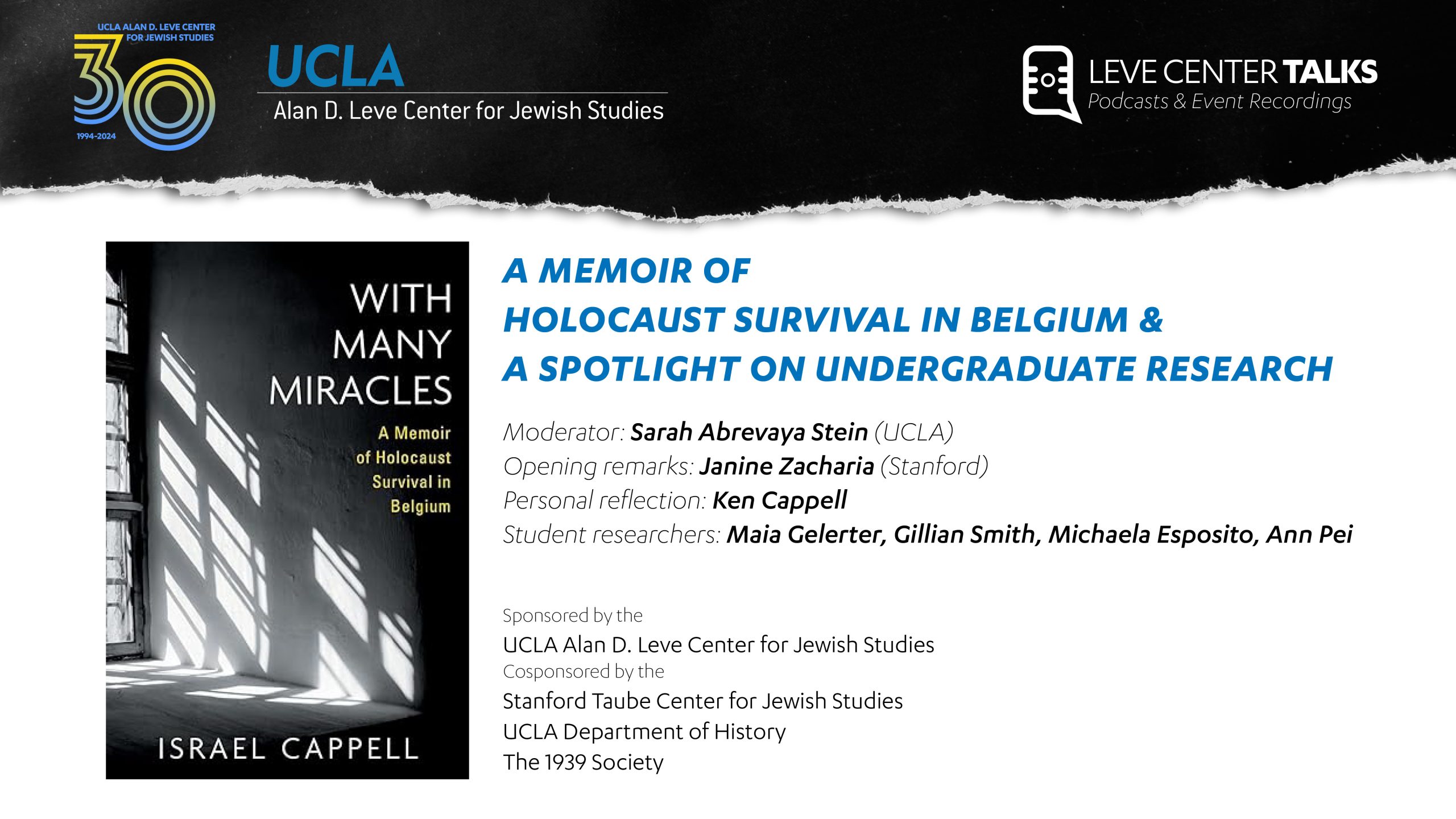
A Memoir of Holocaust Survival in Belgium & A Spotlight on Undergraduate Research
Moderator: Sarah Abrevaya Stein (UCLA), Opening remarks: Janine Zacharia (Stanford), Personal reflection: Ken Cappell, Student researchers: Maia Gelerter, Gillian Smith, Micaela Esposito, Ann Pei
March 13, 2024
The Alan D. Leve Center celebrates the publication of With Many Miracles: A Memoir of Holocaust Survival in Belgium, by Israel Cappell and co-edited by Sarah Abrevaya Stein, Janine Zacharia, and Netty Gross. On April 27, 1944, Polish-born Israel Cappell was awakened by the dreadful knock on the door that he and his family had feared since they began to hide from the Nazis in their adopted city of Brussels two years earlier. Israel’s sister Fanny managed to flee, one of many consequential miracles that shape this riveting memoir of Holocaust survival. Israel takes the reader on a futile journey of attempted escape after the Nazis’ occupation of Belgium. He narrates the daily challenges of hiding and describes his ultimate incarceration in SS-Sammellager Kazerne Dossin, the Nazis’ transit camp in Belgium. Israel also details the remarkable story of his family’s rescue from deportation to Auschwitz via the Palestine Exchange Lists – a little-known arrangement involving the Nazis, the Red Cross, and the Jewish Agency. Israel’s memoir is among the rare, English-language testimonies of Holocaust survival in Belgium. It is also an extraordinary story of human endurance and survival. This event unites in conversation the book’s editors, Israel Cappell’s son Ken Cappell, who was instrumental in bringing his father’s memoir to print, and three UCLA undergraduates, all Leve Student Fellows, who assisted the book’s production: Michaela Esposito, Maia Gelerter, and Gillian Smith.
Cosponsored by the Stanford Taube Center for Jewish Studies, the UCLA Department of History and The 1939 Society
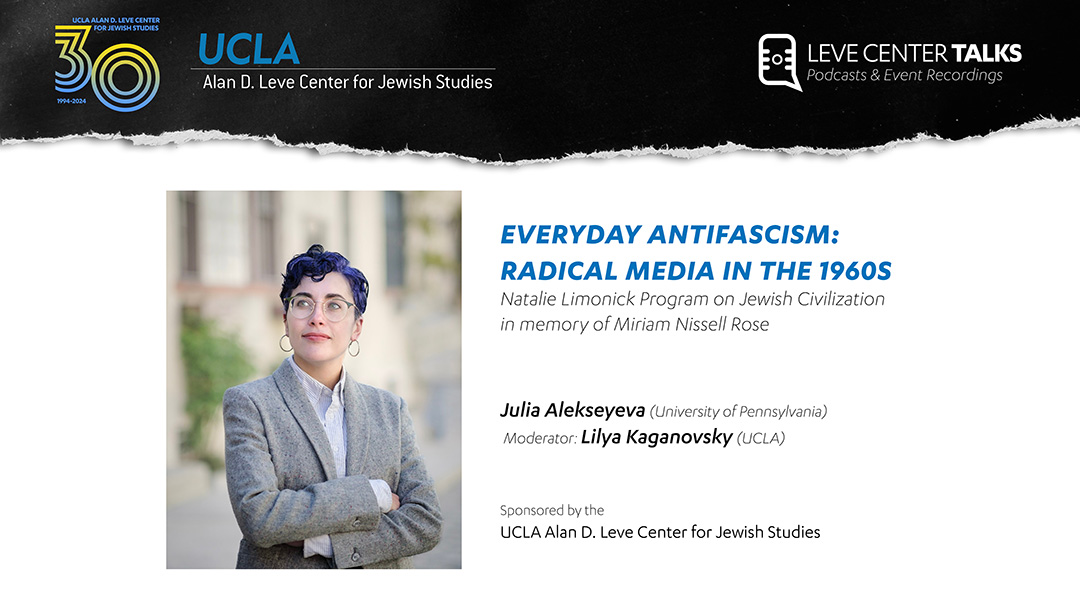
Everyday Antifascism: Radical Media in the 1960s
Julia Alekseyeva (University of Pennsylvania) Moderator: Lilya Kaganovsky (UCLA)
March 5, 2024
This talk presents an analysis of experimental documentary in the 1960s, especially from France and Japan, through the overarching lens of antifascism. Central to the theoretical grounding of antifascism are two Marxist theoreticians who likely never met, but whose work and analysis of antifascist discourses are profoundly aligned: filmmaker Matsumoto Toshio, and philosopher Gilles Deleuze and psychoanalyst Félix Guattari. Matsumoto was the first theorist to explicitly describe avant-garde documentary as an antifascist form, and his writings elaborate most clearly on the necessity of this genre in the postwar moment, in the aftermath of the Holocaust, imperialist terror, and nuclear annihilation. I compare Matsumoto’s concept of aesthetic antifascism—what he terms “aesthetic sado-masochism”—to Deleuze and Guattari’s concept of “microfascism” in the two-volume Capitalism and Schizophrenia, recently analyzed by Jack Z. Bratich (On Microfascism, 2022). As this talk argues, both Matsumoto and Deleuze/Guattari view antifascism as integrally connected to the personal and psychological. This talk will demonstrate how experimental documentary, stretching from the Soviet experiments of Dziga Vertov to the present moment, becomes a privileged art form that is uniquely capable of battling against a non-state and everyday fascist ideology—the “cops in our heads,” in the parlance of May 1968—and against forces of conservativism and complacency.
Natalie Limonick Program on Jewish Civilization in memory of Miriam Nissell Rose
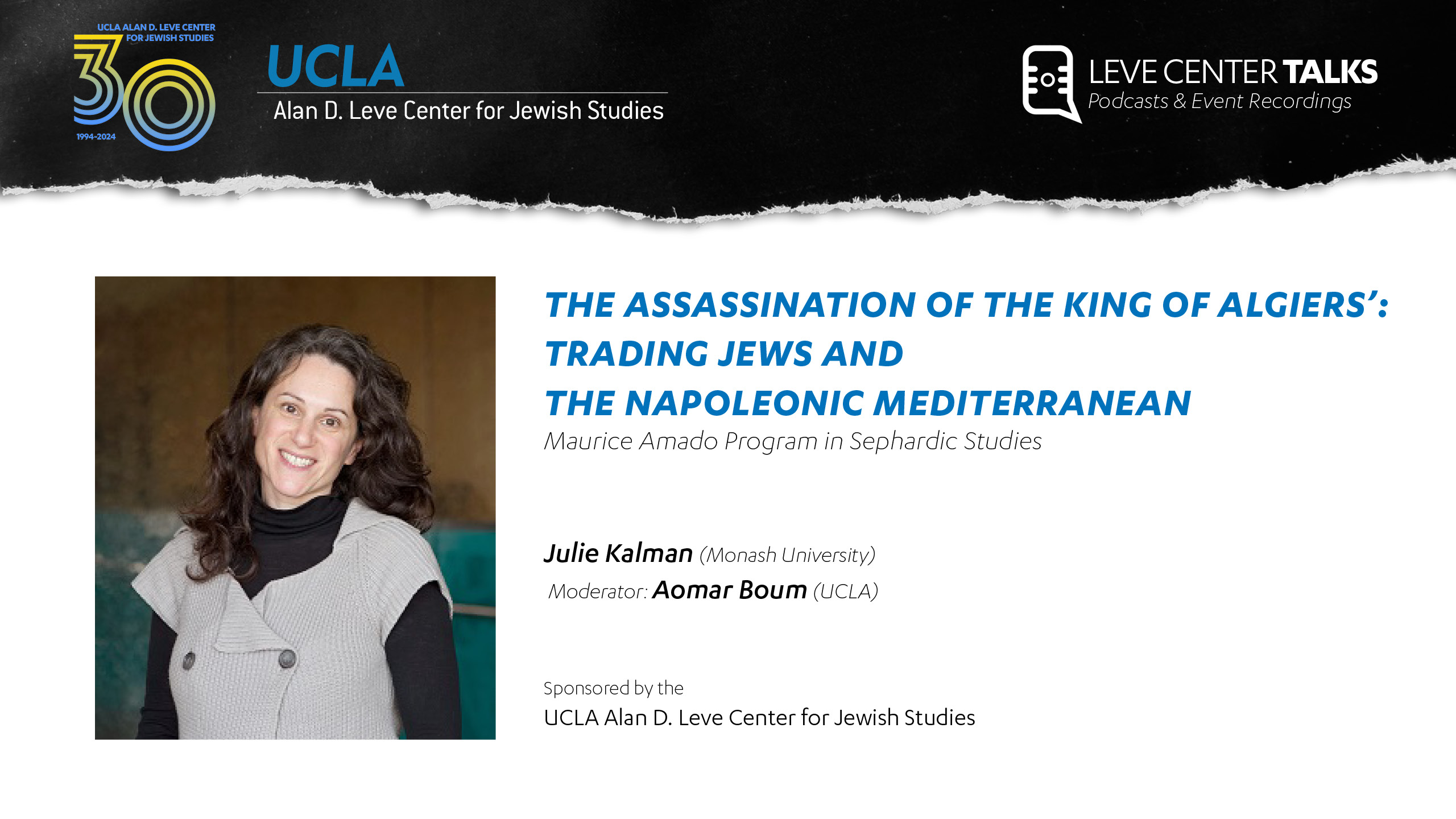
The Assassination of the King of Algiers: Trading Jews & the Napoleonic Mediterranean
Julie Kalman (Monash University) Moderator: Aomar Boum (UCLA)
February 26, 2024
On June 28, 1805, in the port of Algiers, Naphtali Busnach was assassinated, fatally stabbed in the street by a janissary. Busnach was a member of the extended Bacri family, trading Jews in the Regency of Algiers, a semi-independent regency on the western edge of the Ottoman Empire. The news of Naphtali’s death was reported in London and Paris, in the Times and the Journal des Débats. Foreign consuls in the port city sent news of the event to their respective ministers in London and Paris, but also Washington and Madrid. How is it that Naphtali Busnach was so well known, that his death was news in the metropoles of the west? In this conversation, I will explore the reactions to his murder, what they can tell us about Busnach’s place in the regency, and the broader significance of Jewish commerce in the Mediterranean in the age of Napoleon.
The Maurice Amado Program in Sephardic Studies
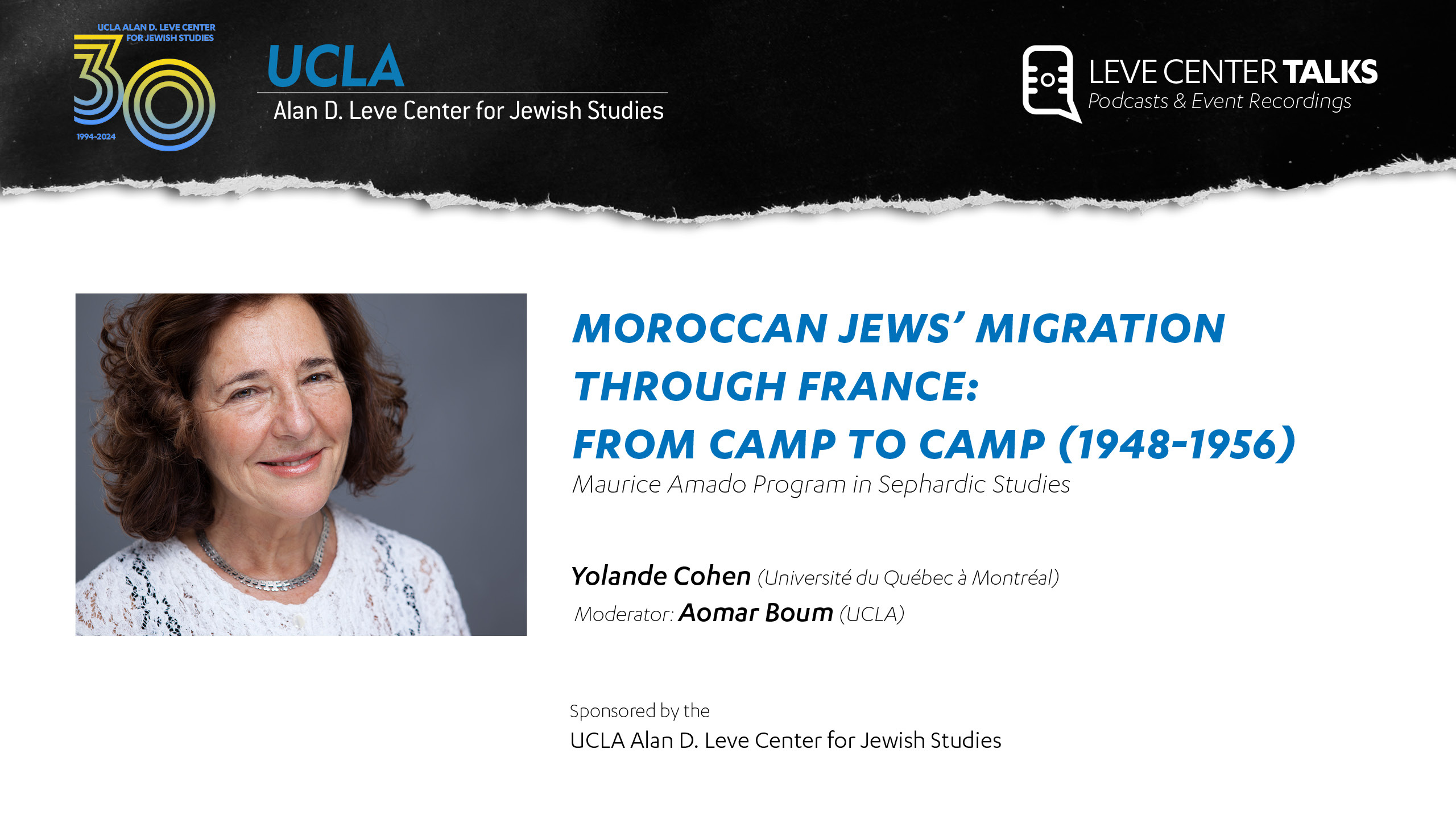
Moroccan Jews’ Migration through France: From Camp to Camp (1948-1956)
Yolande Cohen (Université du Québec à Montréal) Moderator: Aomar Boum (UCLA)
February 1, 2024
Professor Cohen’s personal search for her birthplace in Aubagne brought a discovery of dozens of transit camps in southern France. Searching in the French archives for the specific camp where she and her parents had spent a few years (1948-1953), she came across thousands of names of Jews from North-Africa that went through those camps, exiting Morocco, transiting in those camps in France, before boarding ships to Israel.Because this liminal moment in their migration is mostly ignored, Cohen will explore here the clandestine and complex organization that brought the French administration to allow those camps to flourish in its periphery, in the aftermath of the Shoah and during Morocco’s fight for independence from France.
The Maurice Amado Program in Sephardic Studies

Rain of Ash: Roma, Jews, and the Holocaust
Ari Joskowicz (Vanderbilt) Moderator: Michael Rothberg (UCLA)
January 25, 2024
Jews and Roma died side by side in the Holocaust, yet the world did not recognize their destruction equally. In the years and decades following the war, the Jewish experience of genocide increasingly occupied the attention of legal experts, scholars, educators, curators, and politicians, while the genocide of Europe’s Roma went largely ignored. In this talk, Joskowicz explores the simultaneous suffering of Roma and Jews during the Holocaust as well as the unequal yet necessary entanglement of their quests for historical justice and self-representation in the decades following the war.
The 1939 Society Program in Holocaust Studies

At the limits of language: Poetics amidst Violence
Grzegorz Kwiatkowski (Poet & Musician) Moderator: Rachel Kaufman (UCLA)
December 6, 2023
Grzegorz Kwiatkowski’s work sits at the edges of language’s capabilities. His poetry book, crops (OHM editions, 2021), writes from the viewpoints of victims, survivors, perpetrators, and bystanders during the Shoah in Poland. In this event, Kwiatkowski will read from his work and engage in conversation with poet and historian Rachel Kaufman about his poetics and the capabilities and limitations of poetry to preserve violent histories.
The 1939 Society Program in Holocaust Studies
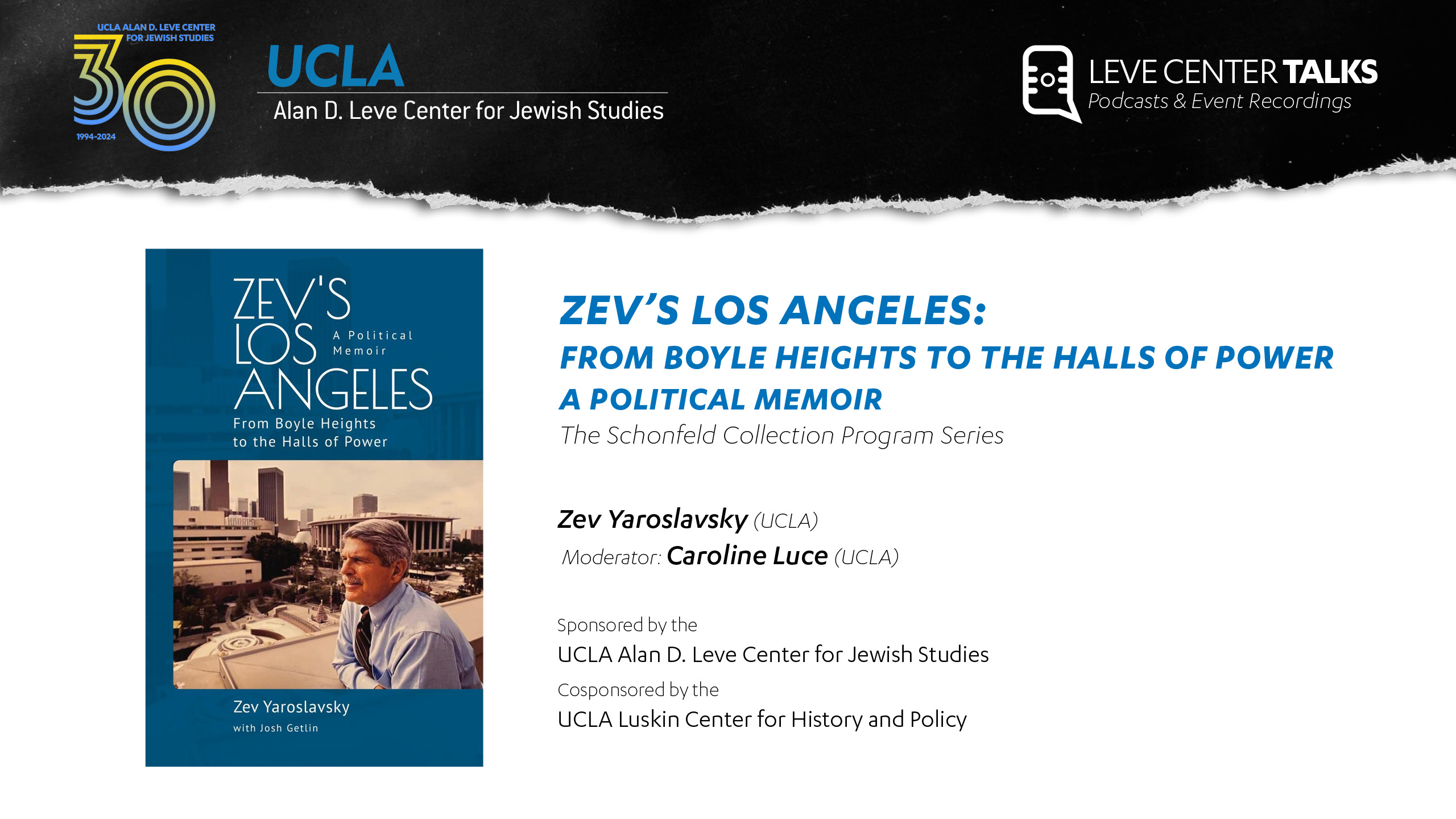
Zev’s Los Angeles: From Boyle Heights to the Halls of Power
Zev Yaroslavsky (UCLA) Moderator: Caroline Luce (UCLA)
December 5, 2023
The book is the story of Zev Yaroslavsky, the son of Ukrainian Jews who immigrated to the United States 100 years ago. Fiercely independent, he combined an activist’s passion with a seasoned politician’s skill to challenge the region’s power brokers. He fought the L.A.P.D.’s excessive force and political intelligence gathering policies; led the effort to ban local taxes from funding the 1984 Olympics; teamed with President Clinton to avert a catastrophic county bankruptcy; helped develop L.A.’s modern transit system; won a bruising battle with real estate interests to save the Santa Monica Mountains from rapacious development; and was pivotal in the development of Walt Disney Concert Hall and the modernization of the iconic Hollywood Bowl.
The Schonfeld Collection Program Series
Cosponsored by the UCLA Luskin Center for History and Policy
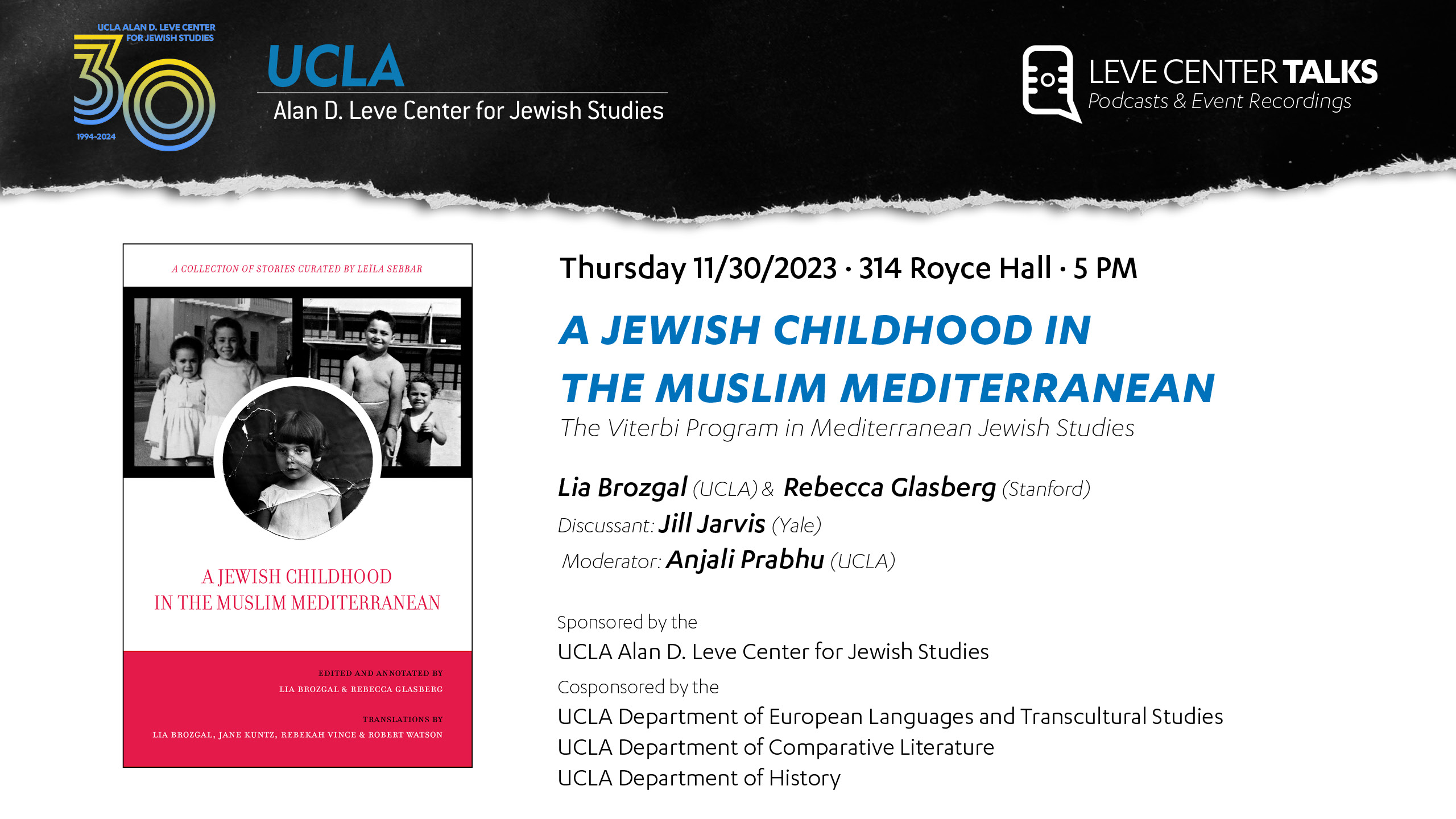
A Jewish Childhood in the Muslim Mediterranean
Lia Brozgal (UCLA) & Rebecca Glasberg (Stanford) Discussant: Jill Jarvis (Yale) Intro: Sarah Abrevaya Stein (UCLA)
November 30, 2023
A Jewish Childhood in the Muslim Mediterranean brings together the fascinating personal tories of Jewish writers, scholars, and intellectuals who came of age in lands where Islam was the dominant religion and everyday life was infused with the politics of the French imperial project. Prompted by novelist Leïla Sebbar to reflect on their childhoods, these writers offer literary portraits that gesture to a universal condition while also shedding light on the exceptional nature of certain experiences. The childhoods captured here are undeniably Jewish, but they are also Moroccan, Algerian, Tunisian, Egyptian, Lebanese, and Turkish; each essay thus testifies to the multicultural, multilingual, and multi-faith community into which its author was born. The present translation makes this unique collection available to an English-speaking public for the first time. The original version, published in French in 2012, was awarded the Prix Haïm Zafrani, a prize given by the Elie Wiesel Institute of Jewish Studies to a literary project that valorizes Jewish civilization in the Muslim world.
Cosponsored by the UCLA Department of European Languages and Transcultural Studies, the UCLA Department of Comparative Literature, and the UCLA Department of History
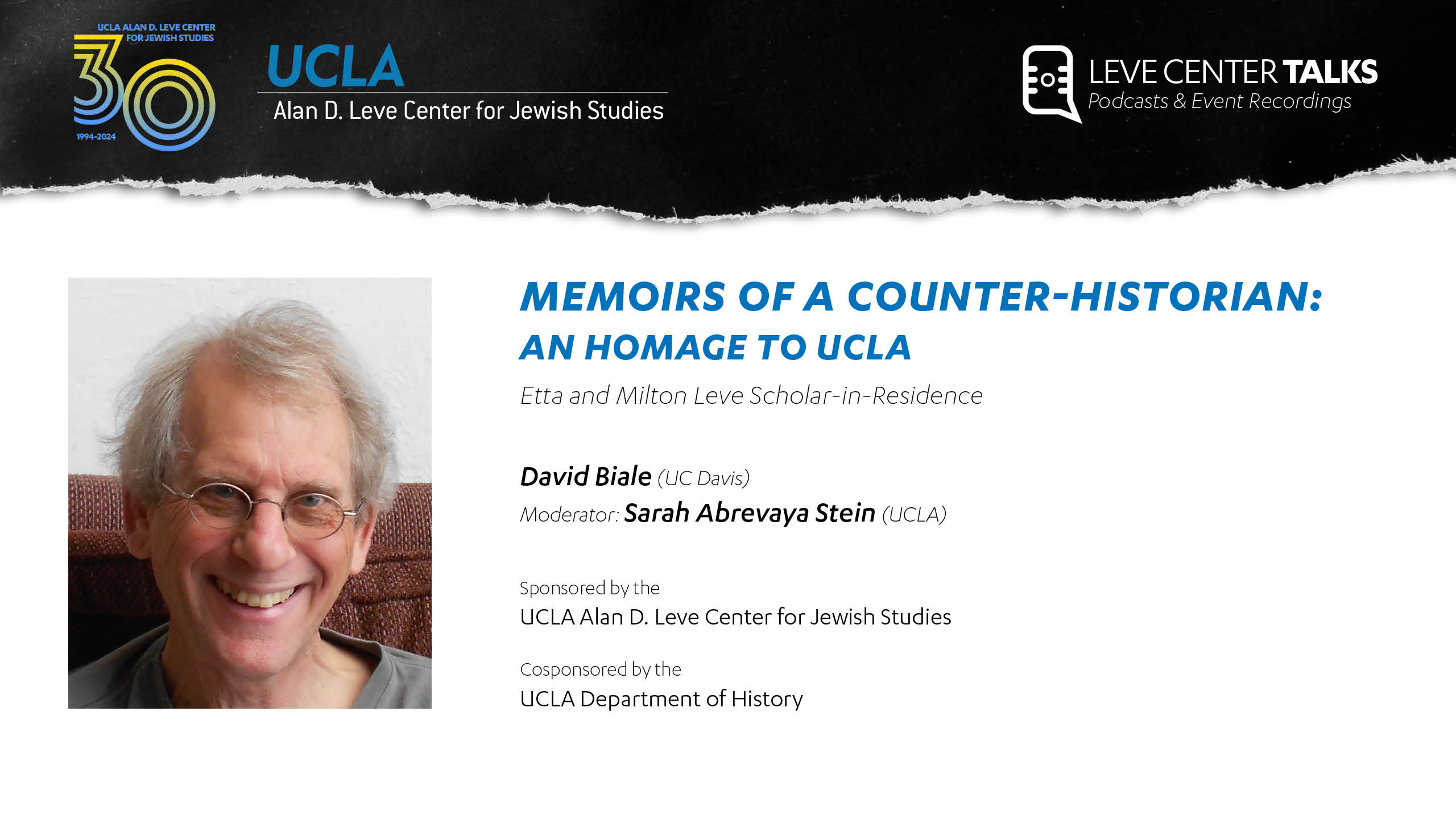
Memoirs of a Counter-Historian: An Homage to UCLA
David Biale (UC Davis) Moderator: Sarah Abrevaya Stein (UCLA)
November 28, 2023
In this talk summing up a long career, David Biale reflects on the origins of his commitment to Jewish Studies in the tumultuous years of the late-1960s and early-1970s. The renaissance of Jewish life in that period was often in conscious interaction with the Weimar Jewish renaissance of the 1920s, a renaissance that drew Biale’s attention to the pathbreaking work of Gershom Scholem about whom he wrote his first and most recent book.
Etta and Milton Leve Scholar-in-Residence Series
Cosponsored by the UCLA Department of History

Resisters: How Ordinary Jews Fought Persecution in Hitler’s Germany
Wolf Gruner (USC) Moderators: Michael Rothberg (UCLA) & Jared McBride (UCLA)
November 16, 2023
Drawing on twelve years of research in dozens of archives in Austria, Germany, Israel, and the United States, this lecture tells the story of Jewish women and men who bravely resisted persecution and defended themselves in Nazi Germany. By expanding the concept of resistance, different categories of individual resistance emerge: written opposition, oral protest, contestation of Nazi propaganda, defiance of anti-Jewish laws and measures, and self-defense against physical attacks. Many of these courageous acts resulted in the resisters of all ages being prosecuted and put on trial; often receiving harsh punishments in Germany and Austria between 1933 and 1943. These stories have not been told until now, and each case is one of many. Taken together, these accounts reframe our understanding of German Jewish attitudes during the Holocaust, challenging the traditional portrayal of Jewish passivity.
The 1939 Society Program in Holocaust Studies